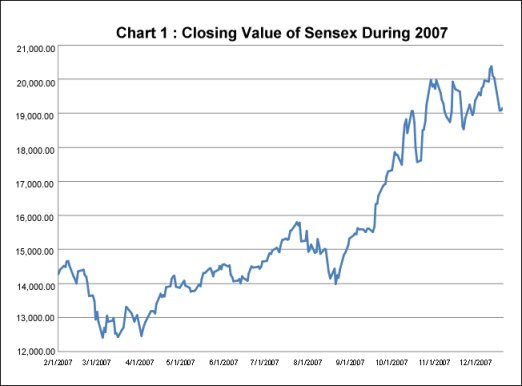
The Sensex still hovers near
the speculative peak it touched recently, having risen
from just below 14000 to more than 20000 (or by around
45 per cent) over a four month period. Fundamentals
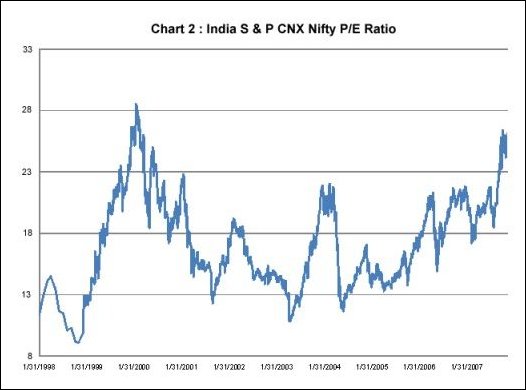
do not seem to warrant this high level. The S&P
CNX Nifty price-earnings (P/E) Ratio is, at around
26, close to the peak of 28.5 it reached during this
decade. Many observers, therefore, feel that some
correction is inevitable since excess liquidity in
the market has driven share prices to levels that
are not sustainable (see Charts).
At precisely this moment when the boom driven by past
speculation threatens to unravel, the Securities and
Exchange Board of India (SEBI) has decided to permit
institutional investors to indulge in short selling,
or the sale of shares that they do not own, and to
restore the Securities Lending and Borrowing Scheme
which will allow market players to borrow stocks to
either sell or honour delivery commitments. A notice
on the SEBI website declares: "SEBI vide its
circular dated December 20, 2007, has decided to permit
short selling by institutional investors. Hitherto,
only retail investors were allowed to short sell.
In order to provide a mechanism for borrowing of securities
to enable settlement of securities sold short, it
has also been decided to put in place a full-fledged
securities lending and borrowing (SLB) scheme for
all market participants in the Indian securities market.
The Stock Exchanges and the Depositories have been
advised to put necessary systems in place in this
regard."
Short selling by institutional investors is not new
to the Indian market. In fact it existed more than
six years back and was banned in early 2001 because
short-selling by a cartel of brokers resulted in a
market collapse. They chose to short sell when they
found out that "big bull" Ketan Parekh in
search of big profits and expecting a spike in stock
prices was building up a strong position in a few
selected scrips in the run up to the budget. What
followed was not just a collapse of the market but
a full-fledged scam. There were three aspects to the
2001 scam. One related to the ability of Ketan Parekh
to make huge purchases of stocks, based on the speculation
that the budget would trigger an increase in stock
prices. The second related to the manner in which
the bear cartel detected Ketan Parekh’s ploy. And
the third related to the ability of the cartel to
acquire large volumes of the concerned scrips to sell
short at the high prices that prevailed because of
Parekh’s acquisitions, in the hope that they could
drive down prices and purchase at low prices to settle
their short positions.
The first two are not of immediate concern today.
Suffice it to say that Parekh was issued pay-orders,
which are in the nature of demand drafts, by the Ahmedabad-based
Madhavpura Mercantile Cooperative Bank (MCCB), without
any reciprocal pay-in of funds either directly in
the form of cash or indirectly in the form of deposits
that could serve as collateral for a loan. MCCB did
that because it was confident it could gain in multiple
ways by Parekh’s speculative activity. The acquisition
of information by the bear cartel was also through
inappropriate means. A sharp rise in prices provided
the signal for the bear cartel to turn suspicious.
The cartel allegedly consisted of stock-market insiders,
including the then BSE chief himself, who in violation
of SEBI norms reportedly checked out from the surveillance
department who was making large purchases and of which
stocks. That was how the cartel discovered that the
rise in the index was the result of speculative purchases
by Parekh of select shares.
Chart
1 >> Click
to Enlarge
Armed with that information the cartel decided to
short sell these stocks, i.e., sell at the prevailing
high prices stocks they did not own. How did they
manage to do that? They used an avenue afforded by
stock-market rules framed in the wake of liberalization
to increase liquidity in the market: the right to
borrow and lend stocks to faciliatate short selling.
Under the Securities Lending Scheme introduced in
1997, holders of stocks lodged with the depository,
like the Stockholding Corporation of India Ltd (SHCIL),
could come to an agreement, implemented through the
intermediary, to lend these stocks to others for a
specified period of time for an interest. Some stocks
holders like the FIIs and institutions like the UTI
and the insurance companies often have large volumes
of individual stocks in their kitty. So long as members
of the bear cartel have information as to which players
have large volumes of specific stocks, they can work
out a deal to borrow these shares, providing them
access.
Knowledge of the existence and source of the required
shares can encourage the practice of short-selling,
or sale of shares not owned by the trader, in the
belief that prices are going down and the shares can
be made good to the actual owner by buying them back
at much lower prices at a later date. That this practice
was resorted to by the bear cartel is clear from the
fact that the SEBI decided to ban short-sales in the
wake of the collapse in stock indices in March 2001.
Thus the bear cartel clearly required little by way
of own resources to indulge in the activities that
led up to the collapse of markets.
Chart
2 >> Click
to Enlarge
The right to short sell and the facility of borrowing
shares to indulge in short selling it emerged was
prone to misuse in a stock markets of the kind that
existed then and continue to exist in India. These
markets are thin or shallow in at least three senses.
First, only stocks of a few companies are actively
traded in the market. Second, of these stocks there
is only a small proportion that is routinely available
for trading, with the rest being held by promoters,
the financial institutions and others interested in
corporate control or influence. And, third the number
of players trading these stocks are also few in number.
This allows speculators with access to liquidity to
influence prices and swing markets. Even before the
Ketan Parekh scam, the SEBI’s Committee on Market
Making had noted the following: "The number of
shares listed on the BSE since 1994 has remained almost
around 5800 taking into account delisting and new
listing. While the number of listed shares remained
constant, the aggregate trading volume on the exchange
increased significantly. For example, the average
daily turnover, which was around Rs.500 crore in January
1994 increased to Rs.1000 crores in August 1998. But,
despite this increase in turnover, there has not been
a commensurate increase in the number of actively
traded shares. On the contrary, the number of shares
not traded even once in a month on the BSE has increased
from 2199 shares in January 1997 to 4311 shares in
July 1998." The net impact is that speculation
and volatility are essential features of such markets.
If factors such as these and the scam experience encouraged
the regulator at that point in time to ban short selling
by institutional investors and the practice of borrowing
and lending stocks, why has it decided that it is
appropriate to reintroduce these practices at this
point in time, when stocks are clearly overvalued.
The argument in favour of such practices is that they
increase liquidity in the market and correct stock
price over-valuation. The fact of the matter, however,
is that at the present moment it is excess liquidity
in the market driven by FII investments that has been
responsible for the stock price overvaluation noted
earlier. Thus during the first 10 months of 2007 (till
November 8) inflows of foreign institutional investor
(FII) capital into the stock market in India totaled
$18.6, as compared with just $3.2 billion during financial
year 2006-07 and $9.9 billion during financial year
2005-06. In the circumstances the requirement is not
one of increasing liquidity in the market but moderating
liquidity so as to prevent a shallow market from registering
equity price increases of a kind that in a matter
of a few months catapult some of India’s capitalists
to the top of the global league of wealthy individuals.
This requires discouraging inflows of financial capital
rather than injection of liquidity that can keep the
speculative spiral going.
If that does happen, short selling facilitated by
the borrowing and lending of shares can encourage
activities of the kind that resulted in the collapse
of the market in 2001. What needs to be noted is that
both in terms of the price earnings ratio and the
nature of the surge in markets the current situation
is either similar to or even more dodgy than that
which prevailed in early 2001. Of course, it could
be argued that the FIIs responsible for the recent
surge are not pigmies of the kind that Ketan Parekh
was, reliant on illegally acquired capital for their
investments. But because these entities are cash rich
and include highly leveraged, speculation-prone institutions
like hedge funds and private equity firms looking
for abnormal returns, some among them might choose
to use the short selling option when markets are high
in the hope that the market can be maneuvered downwards
to ensure large profits. If a 2001-type collapse is
feared, FIIs with a large cumulative stock of investments
can choose to book profits or cut losses and exit,
resulting in a market collapse and a full-fledged
financial crisis.
SEBI has, of course, advised all stock exchanges to
"ensure that all appropriate trading and settlement
practices as well as surveillance and risk containment
measures, etc. are made applicable and implemented
in this regard." It has included in its guidelines
the requirement that institutional investors should
disclose at the time of placing the order whether
the transaction is a short sale or not and that retail
investors must make a similar disclosure at the end
of the trading day, so that the information can be
made public in order to prevent surreptitious speculation.
It has also specifically disallowed "naked short
selling" (or short sales that are not settled
with delivery of shares) and mandated that settlements
under the short selling and securities lending and
borrowing (SLB) schemes shall be on a gross basis
at the client level, with no netting of transactions.
While these elements of caution are welcome, their
objective is unclear. The short selling and SLB schemes
are clearly meant to provide some space speculation
so as to increase liquidity. To then mandate that
such speculation should be transparent and orderly
is self-contradictory. Since markets are doing "well"
and liquidity is as yet not a problem an appropriate
cautionary stance would be one which does not create
more space for speculation in an already overheated
market.

