| |
|
 |
|
|
The
Asian Face of the Global Recession |
| |
| Feb
10th 2009, C.P. Chandrasekhar and Jayati Ghosh |
|
Delegates
to the World Economic Forum at Davos this year came
despondent and left in despair. Both the discussions
and the new evidence released at and during the Forum
indicated that the global crisis was not just bad,
but worse than originally anticipated. One damaging
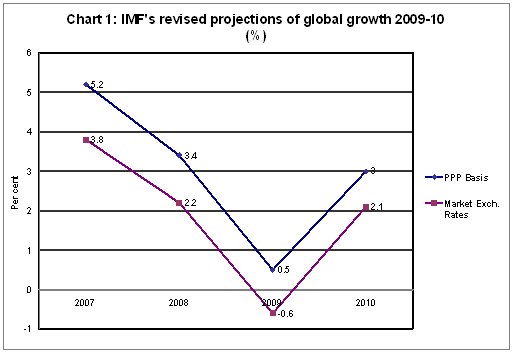
projection came from the IMF in its January 2009 Update
to the World Economic Outlook, which declared: ''Global
growth in 2009 is expected to fall to half percent
when measured in terms of purchasing power parity
and to turn negative when measured in terms of market
exchange rates. This represents a downward revision
of about 1¾ percentage point from the November
2008 WEO Update.'' (Chart 1)
Chart
1 >> Click
to Enlarge
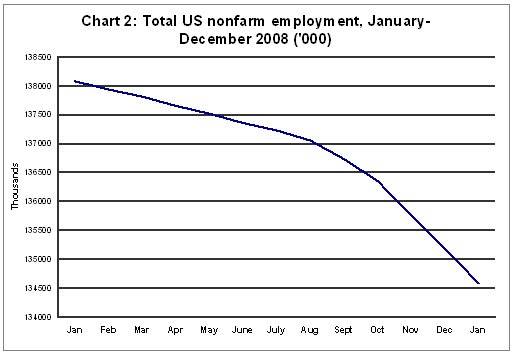
Moreover, data released in recent months by the US
Bureau of Labour Statistics points to a sharp fall
in non-farm employment in the US in recent months
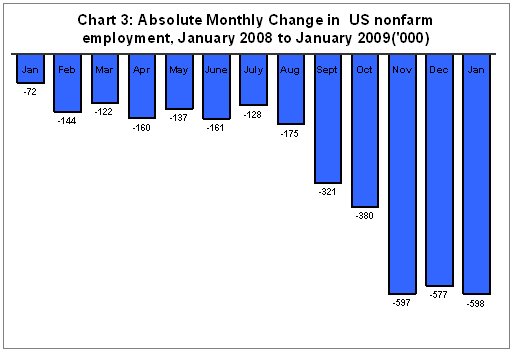
(Chart 2). The monthly decline in nonfarm payroll
employment touched 598,000 in January when the unemployment
rate rose from 7.2 to 7.6 percent. Nonfarm employment
has declined by 3.6 million since the start of the
recession in December 2007, and about a half of this
decline occurred in the past 3 months (Chart 3). The
impact this would have on demand would only aggravate
the recession.
Finally, there is evidence that the global recession
led by contraction in the US is transmitting itself
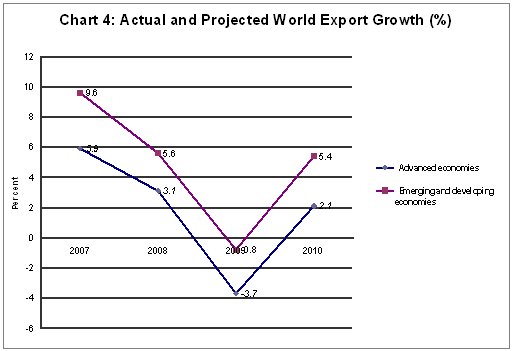
through global trade. Export growth from the advanced
economies is projected to fall from a positive 5.9
per cent in 2007 and 3.1 per cent in 2008 to a negative
3.7 per cent in 2009. But this trend is not restricted
to the developed countries. The relevant figures for
the emerging and developing economies are 9.6 per
cent, 5.6 per cent and -0.8 per cent. (Chart 4). It
is small recompense that growth is projected to rebound
sharply in 2010. Such projections are suspect, since
the IMF has made it a habit of putting out optimistic
projections and then revising them downwards.
Chart
2 >> Click
to Enlarge
In fact, fear of a long recession stems not just from
the distressing developed country figures. It is also
triggered by evidence that the recessionary trend
is affecting Asia as well. Developing economies in
Asia, which as a group grew at 10.6 per cent and 7.8
per cent in 2007 and 2008, are now expected to grow
at just 5.5 per cent or 1.6 percentage points lower
than projected as recently as November last year.
Japan was already contracting by 0.3 per cent in 2008,
and is projected to see that figure falling to -2.6
per cent in 2009. But the three growth engines in
Asia, the ASEAN-5, China and India also now seem to
be badly affected by the crisis. The ASEAN-5 economies,
which grew at 6.3 and 5.4 per cent in 2007 and 2008,
are now projected to grow at 2.7 per cent in 2009
(down 1.5 percentage points from the November 2008
estimates). The corresponding figures for China are
13.0, 9.0 and 6.7 per cent (1.8 percentage points)
and for India are 9.3, 7.3 and 5.1 per cent (1.2 percentage
points). Moreover, the IMF has predicted a damaging
immediate future for South Korea, with its economy
projected to contract by 4 per cent this year.
Estimates from national sources and elsewhere are
less pessimistic than the IMF, but there is consensus
that outside the US it is Asia where the recession
is biting most. This is reflected in available estimates
on rising employment. According to official Chinese
figures, more than 20 million rural migrant workers
have lost their jobs and returned to their homes as
a result of the global economic crisis. According
to these estimates, by January 25, 15.3 per cent of
China's 130 million migrant workers had lost their
jobs and left coastal manufacturing centres to return
home. And the aggregate figure of migrant job loss
does not include those who stayed back in cities in
search of new jobs.
India too has made a feeble effort at estimating the
impact of the downturn on employment. An official
survey by the Labour Bureau focuses on 8 sectors (Mining,
Textile & Textile Garments, Metals & Metal
Products, Automobile, Gems & Jewellery, Construction,
Transport and the IT/BPO industry) to arrive at an
estimate of job loss as a result of the economic slowdown
in the country. In these sectors it sampled units
employing 10 or more workers to make its estimates.
Chart
3 >> Click
to Enlarge
The survey covered 2581 out of the sampled 3000 units
of which 1168 were from the Textile & Textile
Garments industry, followed by 752 in Metals &
Metal Products, 242 in IT/BPO, 132 in Automobiles,
104 in Gems & Jewellery, 103 in Transportation,
19 in Mining, and 61 in Construction. Based on this
limited sample, the total estimated employment in
all the sectors covered by the survey went down from
16.2 million during September 2008 to 15.7 million
during December 2008, implying a job loss of about
half a million (Table 1). The actual decline in employment
if coverage and method were better is likely to be
much higher.
However, the survey does suggest that employment fell
in every month during this period. After September,
2008 employment in all industries declined at an average
rate of 1.01 per cent per month. A comparison of employment
in export and non-export units indicates that employment
declined at an average monthly rate of 1.13 per cent
in the case of the former, as opposed to 0.81 per
cent in the latter (Table 2), pointing to the direct
role of the global slowdown.
Table
1: Trends in Average Employment, India (million) |
Period
|
Average
Employment |
%age
change |
September,08
|
16.2 |
|
|
October,08
|
16
|
-1.21 |
|
November,08
|
15.9
|
-0.74
|
|
December,08
|
15.7
|
-1.12
|
|
Average Monthly
change |
|
-1.01
|
Table
1 >> Click
to Enlarge
These trends in Asia are of significance because at
the time when the crisis was just beginning to unfold,
optimists pointed to Asia as the shock absorber that
would buffer the global downturn. A decoupled Asia,
it was argued, would through its own growth and the
demands that it would make on the world's output ensure
that the financial crisis that was largely a phenomenon
restricted to the developed countries would not have
as damaging an effect on global growth as the pessimists,
then in a minority, were predicting.
Chart
4 >> Click
to Enlarge
Implicit in this confidence was the view that Asia
was a region where the turn to market friendly policies
was undertaken in a form and at a pace that had strengthened
these economies and delivered an ''Asian century''.
When sceptics pointed to the East Asian financial
crisis, they were countered with the view that 1997
was an aberration that resulted from ''cronyism''
or some such intangible and not from liberalisation
and global integration.
Table
2: Percentage change in Employment of Exporting
and Non-Exporting units
|
|
Exporting
Units |
Non-
Exporting Units |
Overall
|
|
October,08
|
-1.3 |
-1.05 |
-1.21 |
|
November,08
|
-0.45 |
-1.24 |
-0.74 |
|
December,08 |
-1.66 |
-0.15 |
-1.12 |
|
Average Monthly
Change |
-1.13 |
-0.81 |
-1.01 |
Table 2 >> Click
to Enlarge
It needs noting that the damage wrought by early liberalization
had forced many Latin American countries to search for
alternative strategies. The resulting turn in economic
policy-making in Latin America has had positive consequences.
In the past a crisis in the US and other developed countries
proved damaging for Latin American countries dragging
them down to degrees far greater than the crisis in
the developed countries itself. However, this time around,
growth in the developing countries of the Western Hemisphere,
which was estimated at 5.7 and 4.6 per cent in 2007
and 2008, is expected to fall to a positive 1.1 per
cent in 2009. That is, the continent seems to have escaped
the kind of contraction it was prone to in the past,
when the global economy faced crises of even lesser
intensities.
It was the poor performance of much of Africa and Latin
America since the 1970s that resulted in Asia emerging
as its showcase, with global capital talking up these
economies and attempting to garner the support of domestic
elites for more liberal policies. As success accompanied
each turn in policy, the shift to a regime that opened
these economies to trade, foreign direct investment
and purely financial flows intensified. Asia came to
symbolise the benefits to be derived from liberalisation
and global integration, and epitomise the view that
the world is flat with no walls to climb.
Over the last two decades and more this shift towards
more open strategies has indeed transformed Asia's relationship
with the rest of the world. While the region was earlier
home to a few mercantilist, export-oriented economies
like Japan, South Korea and Taiwan (Province of China),
in time every Asian economy, including the biggest,
was looking for a market abroad with some like China
proving extremely successful in manufacturing and others
like India in services. Moreover, while Asia could be
proud of a high degree of regional integration through
trade and investment flows, this integration reflected
not the decoupling of Asia from the rest of the world
but the creation of an export platform in which multi-country
production networks created products that were targeted
at world markets. Production processes were segmented,
and each segment located at appropriate sites that generated
intermediate products that were combined at the final
location ( such as China) to be shipped abroad. The
other impact of the process of liberalisation and integration
was a sharp increase in foreign investment flows to
the region, including large inflows of portfolio capital.
A concomitant of this inflow was the liberalisation
of rules regarding the presence and operation of foreign
firms, including financial firms like banks, merchant
banks, insurance companies, hedge funds and private
equity firms. Capital inflows in many countries in the
region were far in excess of that needed to finance
their current account deficits. In fact, some countries
with current account surpluses were also recipients
of large capital inflows.
Given such integration, it is not surprising that an
Asia that was experiencing robust growth till recently
has been affected quite adversely by the global financial
and economic crisis. As the financial crisis unfolded,
foreign financial investors in need of capital to cover
losses and meet margin calls at home unwound their positions
in Asia resulting in a collapse in stock markets in
many Asian economies. Countries like China, India and
Vietnam which had seen their stock markets outperforming
their global ''competitors'' were also the ones that
recorded the steepest falls. The outflow of capital
put pressure on many currencies, forcing central banks
to unwind a part of their reserves. A liquidity and
credit contraction ensued. Foreign financial institutions
that were located in these countries and were facing
difficulties in global markets had to downsize or close,
leading to ripple effects in domestic economies. Domestic
financial institutions exposed to sub-prime mortgage
related assets recorded large losses. Finally, the global
economic recession slowed export growth in these increasingly
export-driven economies. All this generated an Asian
version of the global financial and economic crisis,
which is what the collapse in aggregate growth figures
reflects.
|
| |
|
Print
this Page |
|
|
|
|
