Having
decided to import wheat in sequential lots to beef
up its reserve, the government finds that it is having
to pay continuously rising prices for the commodity.
According to reports, as compared with the weighted
average price of $205 per tonne paid for wheat imported
in 2006-07, the average price paid on tenders floated
on June 26, August 30 and November 12, 2007 was $326,
$389 and $400 per tonne respectively. This takes the
weighted average price paid so far this year to $372
per tonne or 80 per cent higher than in the previous
year. With one more tender floated on November 26
and more imports likely if an early election is planned,
this figure may rise even further.
It is undoubtedly true that with total imports contracted
thus far this year valued at a little more than $600
million, the foreign exchange burden imposed by these
imports is small change when compared to the $270
billion of reserves that India holds. However, the
high price of imports does imply the price paid for
imports is 1.5 to two times the procurement price
offered to domestic farmers. Since these imports are
being used to shore up stocks meant for the public
distribution system, this also means that the budgetary
subsidy for wheat would be that much higher, with
the subsidy being paid to international suppliers
in order to dampen domestic inflation.
While high international prices are the immediate
cause of these outcomes, they also reflect the failure
of the government to ensure adequate domestic procurement
and to assess global price trends. Operating on the
premise that international price would be pushed higher
if India chose to make large imports, the government
may have decided to import the commodity in smaller
lots. But global developments pushed up prices in
any case, making the sequential import strategy a
mistake.
Across the world, food prices, especially those of
staples like grains, have been rising sharply in recent
months. Wheat, the staple used to make bread, pasta,
chapatti and much else, epitomises the trend. The
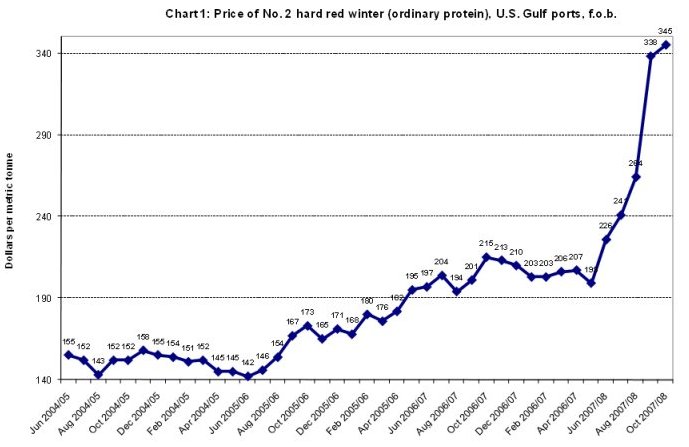
free-on-board price of US-exported "No. 2 hard
red winter wheat", which stood at $199 per metric
tonne in May of 2007, rose by 70 per cent to touch
$345 per metric tonne in October 2007.
The surge in prices of this globally consumed staple
has triggered widespread protests. Italian consumer
organisations even called on members to "sacrifice"
their (wheat-based) pasta consumption for a day to
register their dissent. Protest of this sort has set
policy makers in search of explanations for what investment-banking
firm Merill Lynch has reportedly termed "agflation".
With agricultural prices conventionally seen as being
determined by the relative levels of demand and supply,
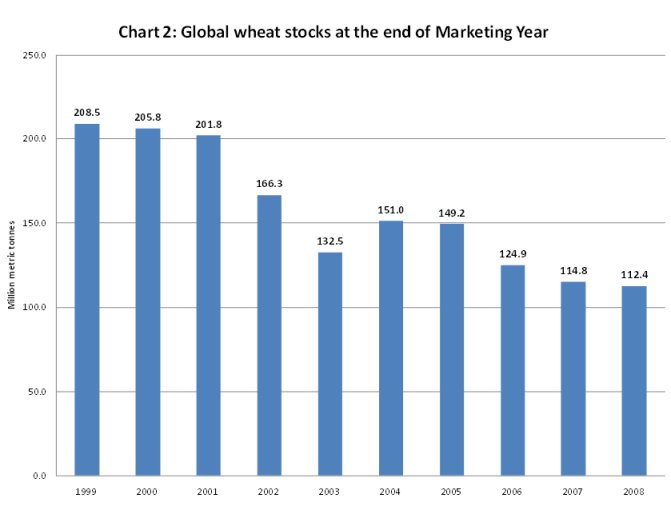
attention is focused on the US Department of Agriculture’s
(USDA) estimate this September that global stocks
of would touch wheat would touch 112.4 million tonnes
at the end of this marketing year (May 2008), their
lowest in 30 years. Year-end stocks have been declining
continuously since the end of marketing year 2003-04,
when they stood at 151 million metric tonnes. That
figure too was below the May 1999 high of 209 million
metric tonnes. Clearly consumption has been running
ahead of production over the long run, almost halving
year-end inventories over a decade
Chart
1 >> Click
to Enlarge
Given
this tendency, any short term changes either in consumption
or supply can result in imbalances that influence
price movements. Moreover, global surpluses are concentrated
with a few nations. World exports of wheat account
for around 18-20 per cent of world production. And,
six countries or groupings-Argentina (8.9%), EU (9.9%),
Russia (11.3%), Australia (12.2%), Canada (13.2%)
and the US (28.2%)-account for close to 85 per cent
of world exports. Given this context, the USDA blames
supply side developments in these countries for the
upward pressure on prices. For example, Canada’s wheat
output is expected to fall by roughly a fifth this
year because of bad weather. Weather-related factors
are also expected to reduce supplies from major exporters
such as the EU, Australia and Argentina, restricting
availability in global markets.
Chart
2 >> Click to Enlarge
Further, the increase in wheat prices this has triggered
is not reducing demand. Not only are big wheat buyers
such as Brazil and Egypt continuing to buy, but import
dependent countries like Japan and Taiwan have rushed
into the market early to secure their supplies. Moreover,
occasional buyers like India, have also been significant
purchasers in recent times. The net effect has been
a surge in prices, argue analysts.
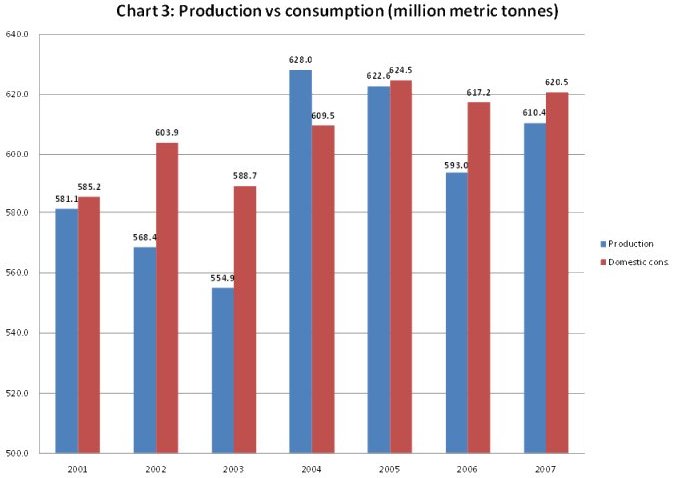
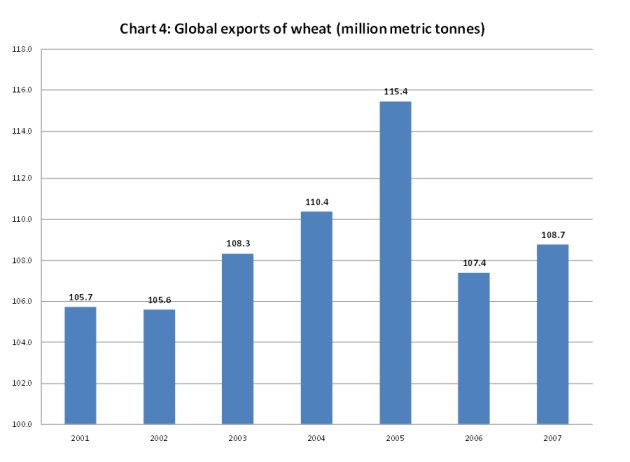
The data partly bears out these trends. The gap between
production and domestic consumption across nations
has been declining in recent years (Chart 3). So countries
have less to export (Chart 4).
However, even accounting for these factors, the extremely
sharp increase in prices in recent months is not easily
explained. Even though global stocks have been falling,
they are still at a comfortable 114.8 million metric
tonnes or 18.8 per cent of global production-a figure
roughly equivalent to the proportion of production
that is globally traded in a year. Taking into account
the fact that rising prices would encourage farmers
to plant more wheat, production can also be expected
to adjust, even if with a lag. For example, though
exports in 2007-08 from the EU and Canada are expected
to fall by 1 million tonnes each and that from Australia
by 1.5 million tonnes because of reduced crop prospects,
exports from Russia and the US are expected to rise
by 1 million tonnes each because of improved production
and the incentive created by higher prices. In the
circumstances the sudden and sharp rise in prices
seems difficult to explain based on demand and supply
alone.
Chart
3 >> Click
to Enlarge
Chart
4>> Click
to Enlarge
Fat and rising margins garnered by monopolistic processors
and retailers and speculation in futures markets are
seen by many to be playing a role. Protesting against
rising pasta prices outside the parliament in Rome,
Carlo Rienzi of the Codacons consumer association
is reported by the Financial Times to have berated
politicians, wholesalers, retailers and speculators-"everyone
but farmers and consumers". Their actions are
seen as having resulted in the accumulation of large
margins as wheat passes from the field to the supermarket
shelf.
The set of players whose trades are least transparent
and whose effect on prices least obvious are investors
in futures markets. When in September, a December
wheat contract traded at the Chicago Board of Trade
at a record $9.11¼ a bushel, it was unclear
whether traders were capturing the level at which
prices are likely to settle come December or influencing
the way prices would move in the weeks to December.
What is clear, however, is that financial investors
(who are speculators by design) see much gain in commodity,
including wheat, futures. Noting that financial investors
have been increasing their stake in these markets,
The Economist (September 6, 2007) recently reported:
"Trading in agricultural futures, once a backwater,
has boomed in recent years. In addition to agri-businesses,
more institutional investors-ranging from hedge funds
to pension funds-are investing. Last year nearly $3
trillion in grain futures was traded on the Chicago
Board of Trade (now part of CME Group), the world's
largest such market." And wheat is one of the
favoured commodities.
The Food and Agricultural Organization also reports
an increase in speculative activity in agricultural
commodity markets. In a recent assessment, the FAO
argued that market-oriented policies are creating
financial opportunities in agricultural markets at
a time when financial markets are awash with liquidity.
This abundance of liquidity has, in its view, "paved
the way for massive amounts of cash becoming available
for investment (by equity investors, funds, etc.)
in markets that use financial instruments linked to
the functioning of agricultural commodity markets
(e.g. future and option markets)." Among such
investors are speculators looking to such markets,
"as a way of spreading their risk and pursuing
of more lucrative returns. Such influx of liquidity
is likely to influence the underlying spot markets
to the extent that they affect the decisions of farmers,
traders and processors of agricultural commodities."
The extent to which these factors have actually contributed
to the recent price increase is yet to be ascertained.
But the fact that demand-supply imbalances and stockholding
levels cannot explain the recent price surge in wheat
and other agricultural commodities has strengthened
the suspicion that they have indeed had an effect.
India is partially insulated from the effects of these
global trends. Exports are not permitted and the minimum
support price rules well below import prices, so that
global "agflation" is not being imported
into the country. But the government’s decision to
allow private players, including large international
firms, a major role in domestic markets has created
a curious situation. According to reports, private
companies (such as ITC, Cargill, AWB India, Britannia,
Agricore, Delhi Flour Mills and Adani Enterprises)
picked up around 20 lakh tonnes of wheat during the
recent rabi marketing season (April-July). While this
may appear small relative to total production such
purchases can make a difference at the margin to prices.
In any case, they affect the ability of the government
to procure supplies to refurbish its reserves. Even
though production of wheat during 2006-07 is estimated
at close to 75 million tonnes as compared with 69
million tonnes in the previous year, procurement fell
short of expectations because the procurement price
of Rs. 8.5 a kg ruled well below market prices that
have ranged between Rs.10 and Rs.12 a kg. Though by
July 19 procurement was, at 11.1 million tonnes, higher
than the 9.2 million tonnes recorded in 2006-07, it
was way below the levels of 16.8 and 14.8 million
tonnes recorded in 2004-05 and 2005-06. With offtake
likely to remain high, this implies that buffer stocks
could fall below comfort levels. If low global stocks
are seen to trigger inflation, an inadequate buffer
stock generates similar fears domestically.
Faced with the prospect of an early election and the
evidence of inflation in global wheat markets, the
government that had earlier reversed a decision to
import wheat has now decided to import the grain,
but in small sequential lots. This, as noted earlier,
has proved costly. A recent clarification attributed
the cancellation of the earlier import decision to
the expectation that global prices would fall in the
wake of the harvest in major wheat producing countries
and the consequent view of the Integrated Finance
Division (IFD) of the Department of Food and Public
Distribution that "a very high benchmark price
would be established for future wheat imports."
With these expectations not being realised the government
has now decided to make the best of a bad situation
created by wrong decisions on domestic trade, procurement
and imports. As clarified by the Union Food and Agriculture
Minister Sharad Pawar, the Empowered Group of Ministers
took the recent import decision, "influenced
by the downward revision of the global wheat production,
apprehensions about some major wheat producing countries
placing restrictions on wheat exports and the Chicago
Board of Trade (CboT) futures showing an upward trend
of wheat prices for December 2007 and March 2008."
It was possibly the Indian decision that resulted
in the sharp rise in US export prices in August this
year. Unfortunately neither the Indian farmer nor
the Indian government is gaining from these trends.
And it is not clear how long the Indian consumer would
be even partially insulated from their effects. Maybe
Carlo Rienzi had got it right.

