Speaking
on the need for more inclusive growth at the recently
held National Development Council meeting to approve
the Approach to the XIth Plan, Prime Minister Manmohan
Singh reportedly said: ''We cannot escape the fact
that the Centre's resources will be stretched in the
immediate future and an increasing share of the responsibility
will have to be shouldered by the States.'' More generally,
his view on resources for the Plan was that much of
the investment needed for rapid growth would come
from the private sector. This, in his opinion, called
for a sound macroeconomic framework, an investor-friendly
environment and a strong and innovative financial
sector capable of responding to the needs of new entrepreneurs.
Implicit in this position are two contentious issues.
The first is the validity of the view that reliance
on the private sector to deliver investment and growth
would not imply an inequalising and less inclusive
path of development, especially if private initiative
is combined with social expenditures financed by the
government. There are indeed many who believe that
the crisis in agriculture (which the Prime Minister
referred to) and the evidence of exclusion (which
he emphasised) are partly the result of the shift
to a private sector-led strategy of growth. In the
event an 8 per cent growth rate notwithstanding, large
sections of the population garner few benefits and
even experience deterioration in their economic position.
The second contentious issue is that in the process
of creating an investor-friendly environment—which
in practice implies substantial tax concessions and
reduced tax rates—the Centre may be engineering an
environment when it finds itself resource-stretched
to finance even crucial capital and social expenditures,
encouraging it to call upon state governments to take
a larger share of the responsibility.
We are here concerned with the second of these propositions.
One striking feature of the period since 1989-90,
which incorporates the years of accelerated economic
reform is that despite evidence of high and accelerating
growth rates and signs of growing inequality, there
has been no improvement in the Centre's ability to
garner a larger share of resources to finance expenditures
it considers crucial. Even when corporate profits
and managerial salaries are reported to be rising
sharply, taxes do not appear as buoyant. The Central
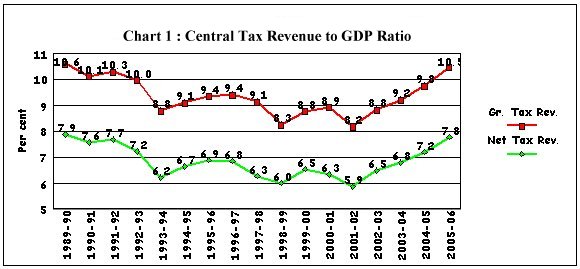
tax-to-GDP ratios in India have been declining for
much of this period. And despite the increase in the
ratio in recent years, their 2005-06 values were at
around the same level they were at in 1989-90 (Chart
1).
Chart
1 >> Click
to Enlarge
This
failure to significantly improve the tax-to-GDP ratio,
in a period when there has also been a widening of
the tax net through various means, is largely due
to the tax concessions provided during the years of
liberalisation. While inequality increases, marginal
tax rates have come down sharply during the liberalization
years. In 1985-86, the marginal rate of taxes on personal
income was brought down from 62 to 50 per cent and
the corporate tax rate from around 60 to 50 per cent.
In the budgets of the early 1990s, especially those
of 1992-93 and 1994-95, the marginal rates were further
reduced to 40 per cent. Today, they stand at around
33 per cent.
As can be seen from Chart 1, the tax-to-GDP ratios
were at their lowest in 2001-02, when they stood at
8.2 per cent in the case of the Centre's Gross Tax
Revenue and 5.9 per cent in the case of Net Tax Revenue,
having fallen from 10.6 and 7.9 per cent respectively
in 1989-90. This decline has occurred despite some
improvement in the collection of Corporation, Income
and Service taxes (relative to GDP) because they could
not cover the loss suffered in customs duty collections
and excise duty revenues as a result of trade liberalisation
and the ostensible ''rationalisation'' of excise duties
(Table 1).
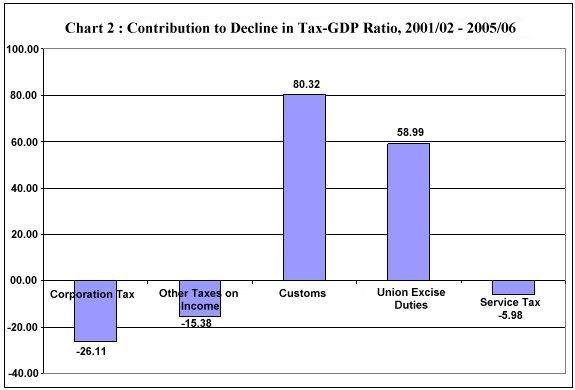
If we decompose the decline in the tax-GDP ratio between
1989-90 and 2001-02, the contribution of the decline
in customs duties relative to GDP amounted to 80 per
cent and that of Excise Duties to 58 per cent. Hence,
despite the neutralising effects of the improved contributions
from Corporation Taxes (26 per cent), Income Taxes
(15.4 per cent) and the newly introduced Service Tax
(6 per cent), the decline in the overall tax-GDP ratio
could not be stalled.
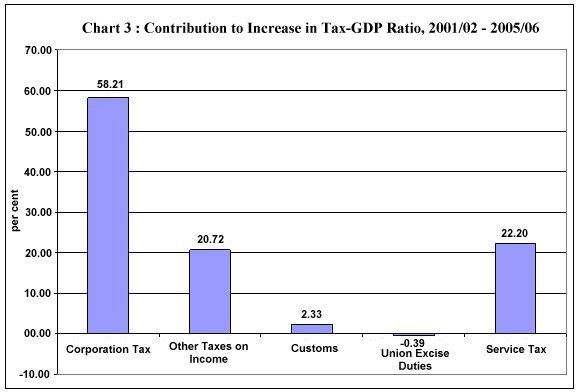
It is indeed true that, subsequently, buoyant corporate
profits, a widened tax base and improved collection
of dues and arrears, have helped raise the tax-GDP
ratio. But despite high growth, improved profitability
and signs of increased inequality (which should improve
tax collection), the increase has just been adequate
to put the tax-GDP ratio back to its immediate pre-liberalisation
levels. This is because, while Corporation, Income
and Service tax revenues (particularly the first)
contributed to the increase, their effect was inadequate
to raise the level above that which prevailed in the
late 1980s.
Chart
2 >> Click to Enlarge
Chart
3 >> Click to Enlarge
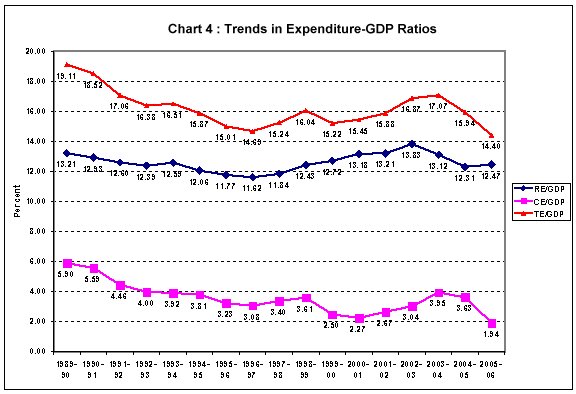
In the event, the Centre has
indeed been strapped for resources to finance its
expenditures. As Chart 4 shows, the ratio of central
budgetary expenditures to GDP fell sharply between
1989-90 and 1996-97. While the ratio regained some
of the lost ground in the latter part of the 1990s
and immediately thereafter, the decline resumed in
2003-04 and was at its lowest level since 1989-90
in 2005-06.
Chart
4 >> Click to Enlarge
Much of this is on account of
curtailment of capital expenditure. Revenue expenditures
as a percentage of GDP, while fluctuating over time,
have more or less retained their level across the
period as a whole. Thus the fall in total expenditure
relative to GDP has been largely on account of cuts
in capital expenditure, which stood at less than 2
per cent of GDP in 2005-06 as compared with 6 per
cent in 1989-90.
What is noteworthy is that the decline in capital
expenditure has been particularly sharp over the three
years ending 2005-06, when the central tax-GDP ratio
has been on the rise. This was because these where
the years when, armed with the Fiscal Responsibility
and Budget Management (FRBM) Act, the government has
been finally realising its ambition to substantially
curtail the fiscal deficit (Chart 5). With revenues
not rising adequately and the fiscal deficit being
curtailed significantly, expenditures had to be cut
to fulfil the FRBM Act, and the axe fell disproportionately
on capital expenditures. This is the reason why the
Prime Minister has to declare that investment and
growth in the coming years will have to be driven
by the private sector.
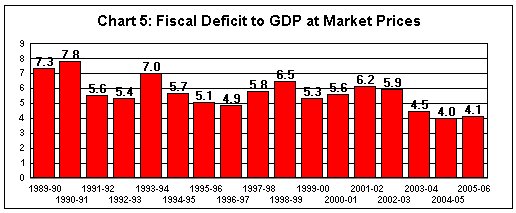
Chart
5 >> Click to Enlarge
Does the pattern of movement
of the different components of tax revenue suggest
that the Centre has exhausted the possibilities of
improving it tax revenues relative to GDP? It could
be argued that the decline in customs revenues was
inevitable, since that was an outcome of unavoidable
trade liberalisation. And since corporation, income
and service taxes have increased, it could be said
that the government had made an effort to partially
neutralise the impact of reduced customs tariffs,
but could not completely deal with the problem.
There are a number of difficulties with that argument.
To start with, it does not question whether tariff
reductions that have such a significant impact on
revenues were justified. In fact, when tariff reductions
were being made, one of the arguments was that trade
buoyancy would ensure that revenue losses would be
marginal. This has not really occurred. Second, it
glosses over the fact that what was considered mere
''rationalisation'' of the excise duty structure,
as part of a process of fiscal reform, has amounted
in practice to the provision of significant excise
duty concessions that have had extremely adverse effects.
Third, it does not raise the question, which has been
raised by the Planning Commission itself, whether
there is any rationale for sharply curtailing the
fiscal deficit, despite its extremely adverse impact
on capital and social expenditures.
Finally, it does not answer the criticism that the
Centre has not gone even part of the way in tapping
resources from direct taxes of various kinds, but
in fact has doled out concessions that are unjustifiable.
A striking example is the income earned from equity
investment. There are two principal ways in which
income is garnered through such investment: dividends
and capital gains. Both have them have benefited from
recent tax concessions. To start with, on the grounds
that corporate incomes are already taxed so that taxing
shareholder dividend income would amount to a form
of double taxation, it was decided in 1999-2000, that
dividends paid out to shareholders should be made
tax-free. Being controversial, this decision was reversed
in the budget for 2002-03, only to be reinstated again
in the Budget for 2003-04.
What has been the fall-out of this exemption? An extremely
revealing analysis by B.G. Shirsat (Business Standard,
July 14 and 22/23, 2006) of 1,050 major dividend-paying,
listed companies has found that dividends paid out
during the three years ending 2005-06 amounted to
Rs. 29,532 crores. Since the beneficiaries of these
dividends are likely to be in the highest marginal
tax bracket, if this dividend income had been subject
to tax, the revenue earned by the government over
these three years would have been an additional Rs.10,000
crore (if we assume that the dividend pay out rate
would have been the same even if the tax was effective).
This is by no means a small sum.
What is noteworthy is the inequality in the distribution
of this tax benefit. It is known that a miniscule
proportion of the domestic population invests in equity.
But even among them, the distribution of dividend
and therefore the benefit of the tax exemption is
highly skewed. Of the close to Rs.30,000 crore of
dividends paid out by these companies, Rs.14,000 crore
or around 45 per cent accrued to the promoters of
the companies themselves. In fact, small or so-called
''retail'' shareholders received a relatively small
share of this benefit. Over ninety per cent of the
shareholders holding up to 500 shares each received
just over Rs.4000 crore of dividend income, while
public shareholders with equity holding in excess
of 500 shares garnered Rs.7,575 crore as dividends.
A significant amount of the dividend paid to public
shareholders went to foreign investors. Foreign institutional
investors (FIIs) received Rs.12, 808 crore of dividend
income during this period and investors in GDRs and
ADRs, NRI investors and other overseas bodies received
Rs.4,567 crore. In sum, a combination of promoters,
high net worth domestic investors and foreigners were
the main beneficiaries of the dividend tax hand out.
There remains the argument that the exemption of dividends
from taxes was not a hand out but the redressal of
an unjust scheme of double taxation. Even if this
is accepted, there remains the fact that there is
a high degree of inequality in the distribution of
incomes in the country, which the accrual of record
dividend incomes seems to aggravate substantially.
If the idea was for the government to garner a fair
share of the surplus for social and capital expenditures,
then the removal of the tax on dividends should have
been accompanied by an increase in the marginal corporate
tax rate. The fact that the government has not chosen
to resort to such an increase only strengthens the
perception that it has failed to tax a section of
the rich adequately and effectively.
The evidence on unwarranted benefits to investors
in equity does not end here. It is visible in the
case of the other form of return from equity holding—capital
gains—as well. The budget for 2003-04 also decided
that, ''in order to give a further fillip to the capital
markets'', all listed equities that were acquired
on or after March 1, 2003, and sold after the lapse
of a year, or more, were to be exempted from the incidence
of capital gains tax. Capital gains made on those
assets held by the purchaser for at least 365 days
were defined for taxation purposes as long term gains.
Long term capital gains tax was being levied at the
rate of 10 per cent up to that point of time.
An analysis of share price movements of 28 Sensex
companies found that if we assume that all shares
purchased in 2004 were sold after 365 days in 2005,
the total capital gains that could have been garnered
in 2005 would have amounted to Rs. 78,569 crore. If
these gains had been taxed at the rate of 10 per cent
prevalent earlier, the revenue yielded would have
amounted to Rs. 7,857. That reflects the revenue foregone
by the State and the benefit accruing to the buyers
of these shares. It is indeed true that not all shares
of these companies bought in 2004 would have been
sold a year-and-one-day later. But some shares which
were purchased prior to 2004 would have been sold
during 2005, presumably with a bigger margin of gain.
And this estimate relates to just 28 companies.
In sum, the stock market alone has become the site
for tax-exempt gains of a magnitude which suggest
that a more appropriate tax policy relating to dividends
and capital gains could have yielded substantial revenues
for the government. This is only one area. There are
many more such which the central government should
look to when looking for money to finance crucial
expenditures. But what the instances quoted prove
is that in the effort not just to facilitate but ''induce''
private investment with tax concessions, the government
is engineering a fiscal situation which is by no means
indicative of a macroeconomic framework that is ''sound''
from a growth and equity point of view.

