It
is often said that "India lives in its states".
This is obviously true, but it is also increasingly
becoming a means of passing on governmental responsibility
from central to state levels. Under the Constitution,
State governments have always had very significant
responsibilities (for law and order, infrastructure
development, health, education, agriculture – to name
just a few). However, at the same time they have not
had commensurate powers either to raise resources
or to influence broader trends that create the context
or enabling conditions for fulfilling these responsibilities.
The assigning of responsibility to states particularly
for economic outcomes is now becoming even more pronounced
in the central government. Thus, in the past week
Ministers in the Central Government Cabinet have argued
that the recent rise in the rate of inflation is the
problem of state governments and must be dealt with
by them. Yet inflation is so clearly a macroeconomic
process that it is obviously determined by aggregate
national forces and policies. These include not only
fiscal and monetary policies, which are the sole preserve
of the central government, but also trade policies
and other features that state governments cannot determine
but must only respond to.
A wide range of other actions – for example, enactment
and enforcement of a Right to Education Bill for the
entire country – are being held up or undermined on
spurious concerns about federalism. At the same time,
it is now common to hear central government spokesmen
argue that "the states are now flush with funds"
because of the increase in sales taxes and therefore
do not require further transfer of financial resources
from the Centre. The basic difference between Centre
and States – that state governments necessarily face
a hard budget constraint unlike the central government
– is forgotten in this context. Also, since the state
governments cannot impose service taxes, and therefore
must exclude the fastest growing segment of the economy
from their resource raising efforts, means that they
are at a significant disadvantage compared to the
central government in this regard.
The basic means of financial transfer is through the
successive Finance Commissions, which are supposed
to ensure a fair and equitable devolution of fiscal
resources from the Centre to States. However, the
terms of reference of recent Finance Commissions have
gone beyond the simple allocation of tax revenues
between Centre and different States according to a
given formula, to allowing and even proposing conditional
transfers, even if this goes against the basic principle
of federal devolution. Thus, the Eleventh Finance
Commission proposed a system of debt relief to states
which required them to first pass fiscal responsibility
legislation according to parameters laid down by the
Centre.
For all the talk of decentralisation, this actually
amounts to a greater centralisation of government
finances. Direct central allocations to states are
increasingly covered by conditionalities, even if
they are egregious or unsuitable to the state in question.
A case in point is the transfer of funds under the
Jawaharlal Nehru National Urban Renewal Mission (JNNURM),
which requires problematic measures such as the elimination
of stamp duty by recipient state governments. Or they
are so rigid as to make it difficult to adjust the
funding to local requirements, as in the case of the
Sarva Shiksha Abhiyan (SSA) where exactly the same
norms for expenditure are laid down for all states
regardless of differing contexts.
Another attempt to undermine federalism and the authority
of elected state governments comes in the arguments
for fiscal provisions by the Centre directly to panchayats
at district level. With norms for expenditure determined
by the Centre, as well as "capacity building"
of panchayat members by the Centre, this amounts to
an extremely centralised notion of decentralisation,
where the real decisions are made at the very top
of national government rather than being delegated
to states and then to panchayats.
In this context, what is the current situation with
respect to the fiscal health of states and financial
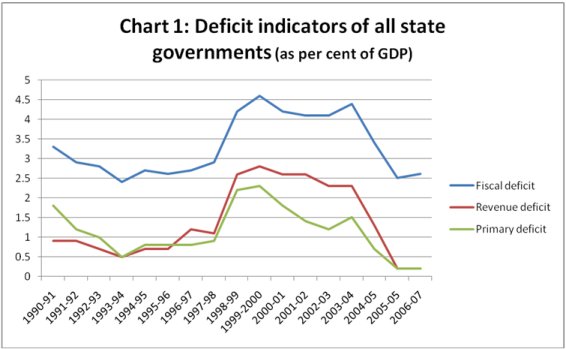
devolution? Chart 1 describes the pattern of deficit
among all state governments taken together. It is
evident that the severe fiscal crisis of the states
that was so marked in the early years of this decade
is no longer as pervasive. Since 2004 all the major
deficit indicators have been declining, and the revenue
and primary deficits are now close to zero for the
states as a whole. Even the fiscal deficit total is
under 3 per cent of GDP.
Chart
1 >> Click
to Enlarge
It is generally supposed that this improved fiscal
health is the reuslt of the Eleventh Finance Commisison’s
award, which is perceived ot have substantially increased
grants to states and also allowed some debt write-off
to those states that agreed to pass the controversial
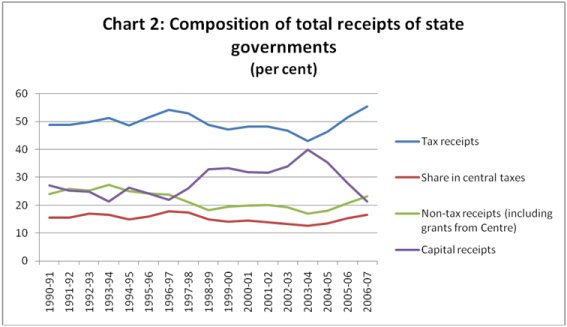
fiscal responsbility legislation. However, Chart 2
indicates that such a conclusion is not justified.
In fact, the significant increase has been in tax
receipts of the state governments themselves, which
in 2006-07 accounted for more than 55 per cent of
their total fiscal resources.
Chart
2 >> Click
to Enlarge
The share in central taxes has remained small and
shown hardly any increase as a proportion of total
receipts. Even all non-tax receipts (which include
grants from the Centre as the biggest chunk) have
not increased veyr much and remain at less than a
quarter of total receipts. It is worth noting that
the share of capital receipts has declined very sharply
in recent years.
Chart
3 >> Click
to Enlarge
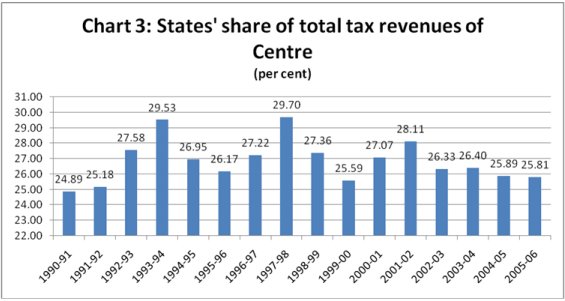
The relatively low and even declining share of central
taxes is confimred by the evidence on the states’
share of central taxes as a proportion of the totla
central tax collection. Chart 3 shows that this has
been declining since the most recent peak of 2001-02,
and that the average of the last three years (2004-05
to 2006-07) is well below the average of the three-year
period of a decade earlier. All the state government
taken together currently receive just around one quarter
of central tax revenues, even though they are directly
responsible for most of the public service delivery
that directly affects the lives of people.
Chart
4 >> Click
to Enalarge
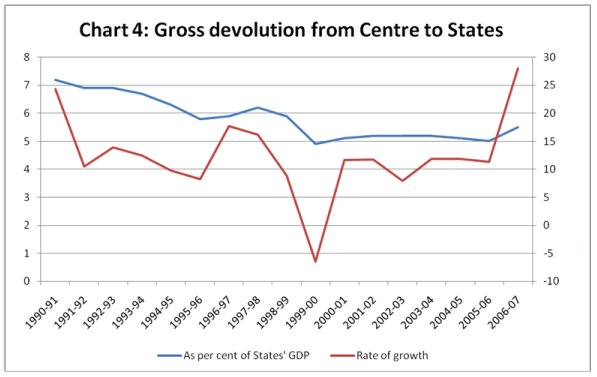
What of the total financial devolution, that is including
grants and all other mechanisms? In current nominal
terms that has certainly been rising, as indicated
by Chart 4 which show the nominal rate of growth on
the right hand scale. However, as share of GDP of
states they have been mostly stganant in the recent
period, and indicate some evidence of medium-term
decline compared to the early 1990s.
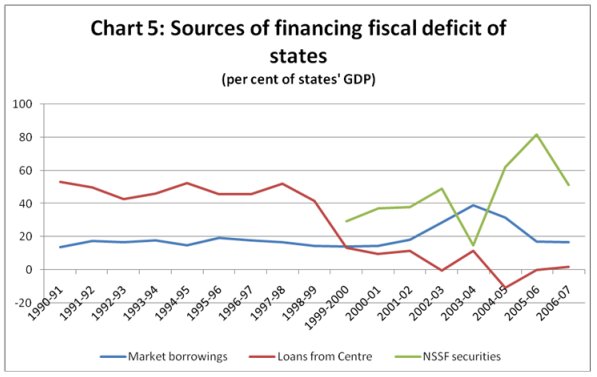
It was noted earlier that capital
receipts had been declining as a percentage of total
state governments’ receipts, and stood at only 21
per cent in 2006-07. Within this, however, the share
of market borrowings increased, as evident from Chart
5 which exmaines the nature of financing the fiscal
deficit for all states. In the last three years described
here there has also been a sharp increase in use of
small svaings (the NSSF or Natioanl Small Savings
Fund) which reflects the shift in personal savings
away from bank deposits to small savings because of
interest rate differentials. This of course means
that state governments have had to pay relatively
higher rates of interest on borrowing even in the
period of lower interest rates on average, but at
least they automatically receive most of these funds.
Evidence from 2007-08 suggests that this was not forthcoming
last year. Meanwhile, loans from the central government
have declined to the point of irrelevance.
Chart
5 >> Click
to Enlarge
It is sometimes believed that grant funds, which are
non-interest bearing and supposedly untied, allow
a greater degree of comfort and flexibility to states,
and indeed the Eleventh Finance Commission put more
emphasis on grants for thosereaosns, as well as because
of the perceived decline in aggregate tax-GDP ratios.
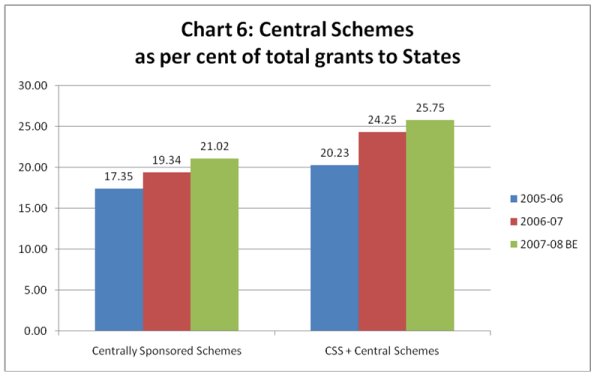
However, a substantial proportion of the grants provided
to the States come in the form of Central Schemes
and Centrally Sponsored Schemes.
Chart
6 >> Click
to Enlarge
Chart 6 shows that not only are these significant,
but they have also been increasing as a proportion
of total grants in the recent period. Strictly speaking,
transfers for Central Schemes should not be included
in such grants at all or counted as part of devolved
resources, since they reflect central government expenditure
that is simply administered by states. Centrally Sponsored
Scehemes are also problematic since they typically
require matching expenditure by states (of varying
proportions acording to Scheme) and are in any case
completely determined by the Centre, in terms of content,
structure, format and process.
So they cannot really be described as devolved funds
at all. This is especially the case given the significant
increase in different forms of conditionality that
now accompany most if not all Centrally Sponsored
Schemes. However, it is apparent from Chart 6 that
more than one-fourth of all grants to States come
in these centralised forms.
All this suggests that fiscal federalism still remains
somewhat of an empty promise in India, despite all
the protestations to the contrary. If this is indeed
the case, and the central government continues to
control the bulk of public finances in India, then
surely it should also take more responsibility for
the eocnomic and social outcomes that are determined
by poublic spending.

