With
the annual rate of inflation in India having touched
7 per cent on a point-to-point basis during the week-ending
22 March 2008, the search for policies to combat the
price rise has begun. One factor seen as making that
search difficult is the ostensible role of "imported
inflation" in driving the rise in domestic prices.
There is an obvious reason why such an argument arises.
Among the products primarily responsible for the current
inflation are food products of different kinds including
cereals, intermediates like metals and the universal
intermediate, oil.
Of these, the difficulties that high and rising levels
of oil prices pose have been known for some time now.
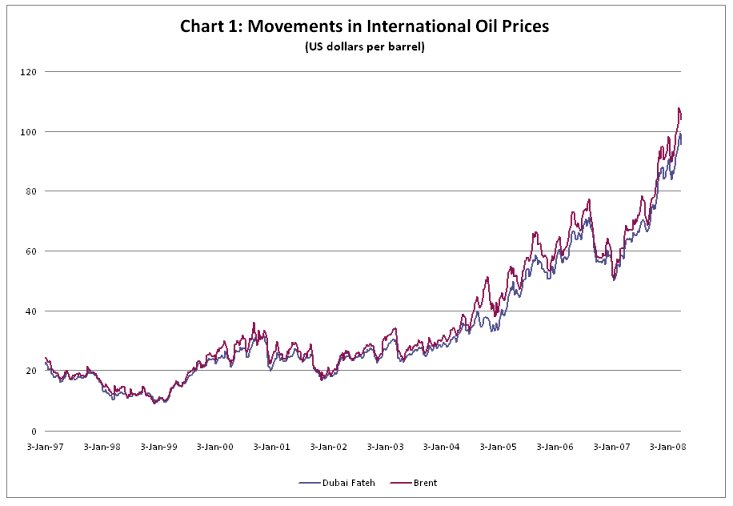
Price movements for the two varieties of crude that
enter India’s import basket (Graph 1) show that since
May 2003 international prices have, despite fluctuations,
been on a continuous rise. In the event the prices
per barrel of these varieties have moved from less
than $25 in May 2003 to close to or well above $100
today.
Chart
1 >> Click
to Enlarge
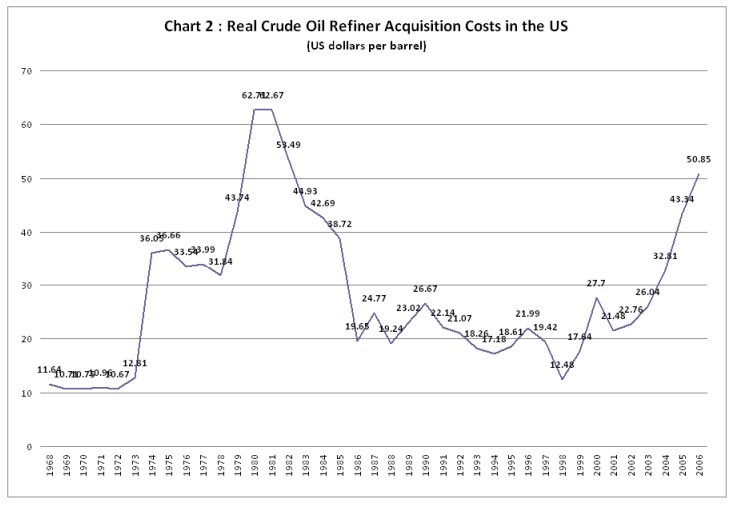
This has changed one feature of the oil price scenario
that held during much of the last two decades. During
those years, despite high nominal prices, the real
price of oil (adjusted for increases in the general
price level) was far lower than that which prevailed
during the 1970s. As Chart 2 shows, when measured
by the price-deflated refiner acquisition cost of
imported oil in the US, in the years since 1974 the
real price of oil was higher than that in 2006 only
during a brief period between 1980 and 1982. Since
2006, nominal oil prices having risen further at rates
much higher than the average level of prices. As a
result, oil producers are regaining the real price
benefits they garnered during the 1979-81 shock. According
to one estimate, in terms of current prices the late
1970s-early 1980s peak in oil prices works out to
$100-110 a barrel. That is a figure that we are fast
approaching.
Chart
2 >> Click
to Enlarge
Underlying the buoyancy
in prices is the closing gap between global petroleum
demand and supply at a time when the spare capacity
is more or less fully utilised. Much of the increase
in demand is coming from China, but that is affecting
stockpiles everywhere. This trend, combined with the
uncertainty in West Asia resulting from the occupation
of Iraq and the standoff in Iran, has created a situation
where any destabilising influence—such as political
uncertainty and attacks on the oil supply chain in
Nigeria—triggers a sharp rise in prices.
What needs noting, however, is that prices are where
they are because speculators have exploited these
fundamentals. It is known that energy markets have
attracted substantial financial investor interest
since 2004, but especially after the recent decline
in stock markets and in the value of the dollar. Investors
in search of new investment targets have moved into
speculative investments in commodities in general
and oil in particular. The Organisation of the Petroleum
Exporting Countries (OPEC), which is normally held
responsible for all oil price increases, has repeatedly
asserted that oil has crossed the $100-a-barrel mark
not because of a shortage of supply but because of
financial speculation.
Views similar to those from OPEC have been expressed
by more disinterested sources as well. As far back
as April 29, 2006 the New York Times had reported
that: "In the latest round of furious buying,
hedge funds and other investors have helped propel
crude oil prices from around $50 a barrel at the end
of 2005 to a record of $75.17 on the New York Mercantile
Exchange." According to that report, oil contracts
held mostly by hedge funds had risen to twice the
amount held five years ago. Such transactions are
clearly speculative in nature.
While the disruption caused by the US occupation of
Iraq, other geopolitical factors and the speculation
that followed has played a role in the case of oil,
what explains the recent increase in other global
commodity prices, especially food articles and metals?
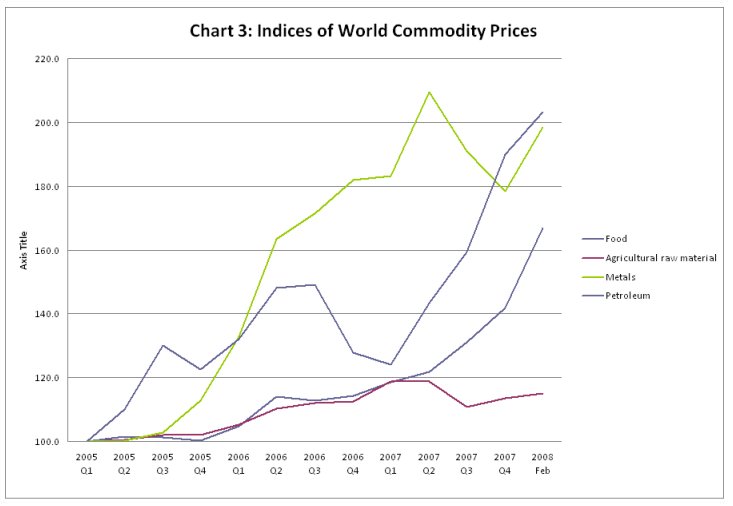
Chart 3 (based on IMF data) shows that, except for
agricultural raw materials whose prices have increased
very little, all the other commodity groups have shown
sharp rises in price. The rise in price levels for
metals was the earliest in the recent surge, with
the weighted average of metals prices increasing sharply
from the last quarter of 2005, and almost doubling
in the two-year period to February 2008. Coal prices
more than doubled last year, thereby showing a faster
rise than even the oil price. Food prices, like agricultural
raw materials, had shown only a modest increase until
early 2007. But since then they have zoomed, such
that the IMF data show more than 40 per cent increase
in world food prices over 2007. The FAO food price
index, which includes national prices as well as those
in cross-border trade, suggests that the average index
for 2007 was nearly 25 per cent above the average
for 2006. Apart from sugar, nearly every other food
crop has shown very significant increases in price
in world trade over 2007, and the latest evidence
suggests that this trend has continued and even accelerated
in the first few months of 2008. The net result is
that globally the prices of many basic commodities
have been rising faster than they ever did during
the last three decades.
It has been argued that these developments are largely
demand driven, being the result of several years of
rapid global growth and the voracious demand from
some fast-growing countries such as China. Certainly
there is some element of truth in this. And to the
extent that this is true, it implies that the world
economy is heading back to the late-1960s and early-1970s
scenario wherein rapid and prolonged growth came up
against an inflationary barrier. Capitalism’s success
over the last two decades was its ability to prevent
such an outcome political economy processes that restrained
the wage and income demands of workers and primary
producers. But clearly there are limits to such a
process, and these limits are now being reached.
If this were the only cause of the recent commodity
price inflation, it would not necessarily be of such
concern to policy makers, because it could then be
expected that a slowing down of overall growth would
simultaneously reduce inflation. It would also reflect
some recovery of the drastically reduced bargaining
power of workers and primary producers. But there
are other, more worrying tendencies in operation,
that suggest that the current global inflationary
process has other factors pushing it which will not
be so easily controlled.
To understand this, it is necessary to examine the
forces behind the prices rises for different commodities.
In the case of food, there are more than just demand
forces at work, although it is certainly true that
rising incomes in Asia and other parts of the developing
world have led to increased demand for food. Five
major aspects affecting supply conditions have been
crucial in changing global market conditions for food
crops.
Chart
3 >> Click
to Enlarge
First, there is the impact of high oil prices, which
affect agricultural costs directly because of the
significance of energy as an input in the cultivation
process itself (through fertiliser and irrigation
costs) as well as in transporting food. Across the
world, governments have reduced protection and subsidies
on agriculture, which means that high costs of energy
directly translate into higher costs of cultivation,
and therefore higher prices of output.
Second, there is the impact of both oil prices and
government policies in the US, Europe, Brazil and
elsewhere that have promoted bio-fuels as an alternative
to petroleum. This has led to significant shifts in
acreage as well as use of certain grains. For example,
in 2006 the US diverted more than 20 per cent of its
maize production to the production of ethanol; Brazil
used half of its sugar cane production to make bio-fuel,
and the European Union used the greater part of its
vegetable oil production as well as imported vegetable
oils, to make bio-fuel. This has naturally reduced
the available land for producing food.
Third, the impact of policy neglect of agriculture
over the past two decades is finally being felt. The
prolonged agrarian crisis in many parts of the developing
world; the shifts in acreage from food crops to cash
crops relying on purchased inputs; the excessive use
of ground water and inadequate attention to preserving
or regenerating land and soil quality; the lack of
attention to relevant agricultural research and extension;
the over-use of chemical inputs that have long run
implications for both safety and productivity; the
ecological implications of both pollution and climate
change, including desertification and loss of cultivable
land: all these are issues that have been highlighted
by analysts but largely ignored by policy makers in
most countries. Reversing these processes is possible
but will take time and substantial public investment,
so until then global supply conditions will remain
problematic.
Fourth, there is the impact of changes in market structure,
which allow for greater international speculation
in commodities. It is often assumed that rising food
prices automatically benefit farmers, but this is
far from the case, especially as the global food trade
has become more concentrated and vertically integrated.
A small number of agribusiness companies worldwide
increasingly control all aspects of cultivation and
distribution, from supplying inputs to farmers to
buying crops and even in some cases to retail food
distribution. This means that marketing margins are
large and increasing, so that direct producers do
not get the benefits of increases expect with a time
lag and even then not to the full extent. This concentration
also enables greater speculation in food, with more
centralised storage.
Finally, primary commodity markets are also attracting
financial speculators. As the global financial system
remains fragile with the continuing implosion of the
US housing finance market, commodity speculation is
increasingly emerging as an important alternative
investment market. Such speculation by large banks
and financial companies is in both agricultural and
non-agricultural commodities, and explains at least
partly why the very recent period has seen such sharp
hikes in price.
Commodity speculation has also affected the minerals
and metals sector. For these commodities, it is evident
that recent price increases have been largely the
result of increased demand, especially from China
and other rapidly growing developing countries, but
also from the US and European Union. A positive fallout
of the recent growth in demand and diversification
of sources of demand is that it has allowed primary
metals producing countries, especially in Africa,
to benefit from competition to extract better prices
and conditions for their mined products. But there
is also the unfortunate reality that higher mineral
prices have rarely if ever translated into better
incomes and living conditions of the local people,
even if they may benefit the aggregate economy of
the country concerned.
At any rate, metal prices are high and likely to remain
high because of the growing imbalance between world
supply and demand. A reduction in global output growth
rates would definitely have some dampening effect
on prices from their current highs, but the basic
imbalance is likely to continue for some time. This
is also because there has been a neglect of investment
in this sector as well, so that building up new capacity
will take time given the long gestation period involved
in investments for metal production.
So the medium term outlook for global commodity prices,
while uncertain, is that they are likely to remain
high even if the world economy slows down in terms
of output growth. What does this mean for India? Until
the 1990s, both producers and consumers in India were
relatively sheltered from the impact of such global
tendencies because of a complex system of trade restrictions,
public procurement and distribution and policy emphasis
on at least food self-sufficiency.
The liberalising policies that began in the early
1990s have rendered all of that history, since one
explicit aim of the reform strategy was to bring Indian
prices closer in line to world prices. Countries like
India seeking to manage this effect of global speculation
on the prices of a universal intermediate like oil
have to decide how important it is to insulate the
domestic economy and the domestic consumer from its
effect. Given the huge revenues being derived from
duties on oil products, one way this can be done is
to forego duty while holding oil prices. This would
require compensating for revenue losses with taxes
in other areas which a growing economy can contemplate.
But the government appears unwilling to take this
route, increasing pressure to hike oil prices further
and aggravate an inflationary tendency that is already
proving to be economically and politically damaging.
This reticence till recently to proactively insulate
the domestic economy has meant, that both producers
and consumers are now more or less directly affected
adversely by global trends. The government’s response
to the domestic price rise, which is already creating
panic in official corridors in an election year, has
been to reduce or eliminate import duties on several
food items such as edible oils, so as to allow imports
to bring the price down. But that is a short-sighted
and probably ineffective strategy. It provides direct
competition to Indian farmers producing oilseeds,
even as they suffer rapidly rising costs. It sends
confused signals not only to farmers for the next
sowing season, but also to consumers, and leaves the
field open for domestic speculators as well because
the imports are not under public supervision but left
to private traders.
Most of all, given the tendency of international commodity
prices noted here, it will not solve the basic problem
of rising inflation in such commodities. Instead,
it will make the Indian economy even more prone to
the volatility and inflationary pressure of world
markets. In fact, the increases in prices in India
have not been as sharp for some commodities largely
because of the vestiges of the intervention era. Thus,
prices of some commodities, like rice for example,
have gone up less than world prices only because exports
have been prohibited. This does suggest that the Indian
economy cannot hope to remain insulated from these
global trends without much more proactive policies
that rely substantially on government intervention
in several areas. In the case of food, this essentially
requires a more determined effort to increase the
viability of food cultivation, to improve the productivity
of agriculture through public measures, and to expand
and strengthen the public system of procurement and
distribution. For other commodities too, it is now
evident that a lassez faire system is simply not good
enough, and public intervention and regulation of
markets is essential.

