Since
euphoria over the BSE Sensex breaching one more psychological
barrier, the 8000 mark, preoccupies the media, new
signs of economic vulnerability remain unflagged and
ignored. According to the latest trade statistics
released by the Directorate General of Commercial
Intelligence and Statistics relating to the first
five months of this financial year (April-August),
the deficit in India's merchandise trade stood at
$17431.2 million as compared with $9728.5 during the
corresponding period of the previous year. This 80
per cent increase in the deficit, if it persists over
the rest of the year, could take India's trade deficit
to close to $50 billion over the financial year 2005-06.
It could be argued that such an increase was inevitable
given the sharp increase in the international prices
of oil, which was and is expected to substantially
increase India's oil import bill. Indeed, over the
first five months of this financial year, oil imports
rose in value by close to 37 per cent, rising from
$12002 million to $16428 million. However, what is
noteworthy is that over the same period non-oil imports
also rose by a similar 37 per cent from $26803 million
to $37763 million. In the event, despite a creditable
23 per cent increase in the dollar value of India's
exports during April-August 2005, the trade deficit
has widened substantially. Even if the increase in
the oil import bill is seen as temporary because oil
prices must moderate and even fall, the same cannot
be said of the non-oil import bill. Clearly import
liberalisation has meant that any buoyancy in the
economy, even if it is not focussed on the commodity
producing sectors, results in import bill increases
that match those generated by events like the current
oil shock. If that increase has to be moderated or
reversed for any reason, lower economic growth must
be the price that has to be paid.
The full significance of this trend comes through
when we note that one comforting feature of India's
balance of trade between 2000-01 and 2003-04 has been
the surplus on the non-oil merchandise trade account
(see Chart). That surplus helped partially moderate
the effects of a rising oil trade deficit, which rose
sharply between 2001-02 and 2004-05, partly because
of a gradual increase in oil prices and partly as
a result of dramatic increases in the domestic consumption
of oil and oil products. However, in 2004-05, the
non-oil trade balance was once again negative, removing
the partial cushion offered by the trade in non-oil
products against the effects of a rising oil trade
deficit at a time when the rise in oil prices was
sharper. What is happening is that, in a period when
oil prices have registered particularly sharp increases,
the non-oil import bill has kept pace with the oil
import bill, resulting in a massive widening of the
deficit on the merchandise trade account.
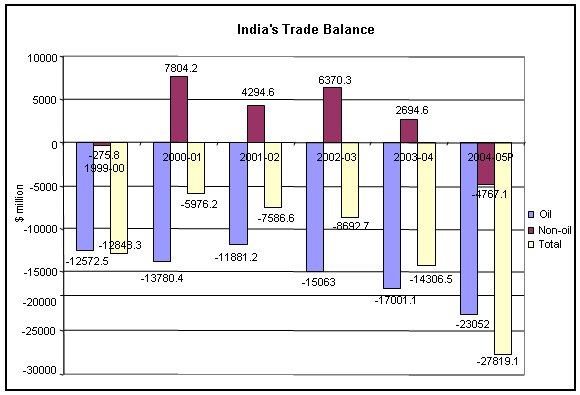
Chart
1 >> Click
to Enlarge
It is of course true that even during the previous
two financial years, the widening deficit on the trade
account was not a cause for concern because of significant
inflows of foreign exchange on account of remittances
and exports of software and IT-enabled serves. According
to the Reserve Bank of India, private transfers brought
in a net amount of $20.5 billion during 2004-05 and
software services exports contributed another 16.6
billion dollars. This net inflow went a long way towards
financing India's foreign exchange requirement in
that year on account of the merchandise trade deficit
and the deficit under other items of what are termed
''invisibles''. As a result, the deficit on the current
account of the balance of payments was relatively
small. Since India has also been a net recipient of
substantial capital inflows on account of debt and
foreign direct and portfolio investment, this led
to a huge accumulation of foreign exchange reserves
that implied a comfortable balance of payments situation.
It now appears that India's relatively strong current
account position is weakening rapidly. As noted above
a combination of rising oil prices and dramatic increases
in non-oil imports is resulting in a substantial widening
of the merchandise trade deficit. Simultaneously,
there is evidence that recent increases in remittance
inflows are tapering off. Net remittances, which rose
from $16.4 billion in 2002-03 to $22.6 billion in
2003-094, was down to $20.5 billion in 2004-05. While
net revenues from software services, continue their
increase from $8.9 billion in 2002-03 to $11.8 billion
in 003-04 and $16.6 billion in 2004-05, the current
account can be expected to widen because of the other
two developments.
Consequently, a greater share of the net capital flows
that India attracts in the form of debt and foreign
direct and portfolio investment would now be needed
to finance the current account deficit. This would
be perfectly acceptable if these capital inflows were
being used to build productive capacities that can
support exports and earn the foreign exchange needed
to meet future foreign repayment commitments that
today's inflows imply. That, however, is clearly not
happening. Portfolio flows create no additional capacities,
though FII investments drive the current stock market
boom and create the euphoria that explains the lack
of concern about potential external vulnerability.
And to the extent that foreign debt and direct investment
inflows are indeed creating new capacities, they are
not generating export revenues to finance the rising
non-oil and oil import bill.
This is not surprising. It has been clear for some
time now that unlike what occurred in the late 1980s
and early 1990s in second-tier East Asian industrialisers
like Thailand and Malaysia, and very much unlike what
has been happening in China for close to a decade-and-a-half
now, ''non-financial'' investments financed with foreign
capital in India have not been directed at greenfield
projects that contribute to an expansion of exports.
Rather, they have principally been: (i) directed at
increasing the share of foreigners in firms they already
control consequent to the relaxation of ceilings on
foreign holdings in domestic joint ventures catering
to the domestic market; (ii) used for acquisitions
of local firms that provide foreign investors with
a share in the domestic market for a range of products;
and (iii) concentrated in greenfield projects in infrastructural
services such as power and telecommunications, which
in any case are sectors that produce ''non-tradables'',
or services that are not normally exported to foreign
markets.
The only area in which an increase in foreign presence
involves export revenues as a rule is the software
and IT-enabled services sector. But even though export
revenues from this sector have been rising rapidly,
the sector is still too small to make up for the foreign
exchange profligacy of the rest of the economy. Overall
import liberalisation, combined with a concentration
of incomes in sections of the population with a significant
pent-up demand for imported or import-intensive goods,
has resulted in an excess of demand for foreign exchange
relative to current account earnings.
The incipient tendency towards external vulnerability
that this entails has thus far been ignored for two
reasons. First, India's exports have been performing
better in recent years than they did in the past.
Second, India has been such an attractive destination
for foreign financial investors that inadequacy of
foreign exchange has become a feature of a rarely
remembered past.
Other than for 2001-02, when India's exports declined
marginally, exports in dollar terms have been rising
at over 20 per cent an annum over most years of this
decade. This has been the focus of statements by Commerce
Ministry spokespersons. As and when any reference
is made to import growth, a rise in the import bill
is presented more as evidence of recovery in the industrial
sector, rather than as a cause for concern because
that rate has implications for the merchandise trade
deficit.
Implicit in this view is the belief that a trade deficit
does not matter, since invisible revenues ensure that
a rise in the trade deficit does not automatically
translate into a rise in the current account deficit
and that, even if it does, capital flows are more
than adequate to cover the likely increase in the
current account deficit. Recent experience has shown
that the import surge is such that even with reasonable
export growth this view is no longer true. What is
more, periodic currency crises elsewhere in the world
suggest that reliance on purely hot money flows to
finance such a current account deficit is by no means
a sensible strategy.
But there is a more fundamental problem here. The
success of any liberalisation strategy depends in
the final analysis on the realisation of a rate of
export growth that can deliver growth without balance
of payments problems that are structural. This makes
comparisons of the rate of export growth over time
meaningless. Allowing for a reasonable lag, what is
needed is a rate of export growth at any point of
time that covers the increase in imports that liberalisation
involves as well generates the revenues needed to
meet commitments associated with capital inflows.
It would be absurd to use more capital inflows to
cover past capital flow commitments, since this involves
a spiral of dependence on capital inflows. Such dependence
implies even greater fragility if such capital flows
are of a kind that are footloose and investors can
exit the country with as much enthusiasm as they showed
when they entered.
What the evidence on India's trade trends suggest
is that even as dependence on volatile capital flows
increases, an export growth rate that is presented
as creditable appears increasingly adequate to cover
the import surge in non-oil imports. Add on a surge
in the oil import bill and that inadequacy is all
the greater. This implies that the dependence on volatile
flows to sustain the balance of payments is rising.
If the current boom in the stock market reaches its
inevitable peak, then not only will new capital flows
dry up but past capital flows would seek to exit the
country. That is a denouement that must be avoided
if India is not to follow the example of ''emerging
markets'' like Mexico, South Korea, Thailand, Indonesia,
Malaysia, Brazil, Turkey and Argentina. If it does,
then it could be the next case where a financial crisis
can be the means to ensure neo-colonial conquest of
a country whose elite sees itself as populating a
rising global power.

