Democracy yields many dividends. Important among them
is the pressure on governments, however neo-liberal
in inclination, to pay heed to sentiments that can
determine political legitimacy and make a difference
to electoral outcomes. Over the last year, it has
been obvious that the economic decision-makers within
the UPA government have a strong preference for neo-liberal
policies. Yet, they have had to accept, even if with
much reticence and hesitation, that markets are often
prone to fail, necessitating intervention by the state.
Among the few areas where such good sense appears
to now prevail is the direction of credit to priority
sectors.
A draft Technical Paper prepared by an internal working
group of the Reserve Bank of India (RBI) has recommended
correcting the dilution of priority sector credit
provision. The constitution of the working group was
triggered by a December 2004 decision to revitalise
priority sector credit, which was followed by a reference
in the Annual Policy Statement of the Reserve Bank
of India to a view that enlargement of areas eligible
for priority sector lending had resulted in a loss
of focus and that ''credit growth in housing, venture
capital and infrastructure has been strong while it
has been sluggish in agriculture and small industries.''
The working group's mandate therefore was to revisit
the need for priority sector lending and assess the
demand for course correction in the implementation
of the programme.
Since the mid-1960s, credit has been seen as an important
instrument of development policy in India. The agrarian
crisis of 1964-66, the industrial deceleration and
overall economic stagnation that followed and the
political instabilities these generated, brought home
the point that crucial institutional constraints to
growth had not been addressed during the early planning
years. This had not only resulted in a development
impasse, but necessitated attention to the deep inequities
that characterised whatever development that had occurred.
Though this realisation did not trigger any fundamental
institutional reform, such as the redistribution of
land, it ensured the adoption of at least some much-needed
policy initiatives, among which was a programme of
priority sector lending. It was clear by then that
India's then predominantly privately owned banking
system was not geared to or interested in delivering
credit to a range of sectors outside of large industry.
Influenced by the fact that credit was an important
component of the Green Revolution ''package'' aimed
at stimulating agricultural growth, and confronted
by the sectoral and unit-wise concentration of credit
delivery, a decision was taken in 1967-68 to consciously
direct credit to priority sectors such as agriculture,
small-scale industry and exports.
After 1969, when 14 major commercial banks were nationalised,
the government went much further in this direction.
In the event, the priority sector was defined to include
Agriculture, Small Scale Industry, Small Road and
Water Transport Operators, Retail Trade, Small Business,
Professional and Self Employed Persons, State sponsored
schemes for Scheduled Castes/Scheduled Tribes, Education,
Housing and Consumption.
However, among these sectors the emphasis was to be
on agriculture, small industry and small business.
At present, the programme requires that priority sector
advances should constitute 40 per cent of net bank
credit (NBC) of domestic banks. The sub-target for
the agricultural sector stands at 18 per cent of total
advances. Further, 60 per cent of advances to the
small scale sector are expected to be directed to
the tiny sector. And, 10 per cent of net bank credit
has to be directed towards weaker sections. (The requirement
set for foreign banks was lower—at 32 per cent—and
the sectoral composition too was more lenient.)
However, over the last decade, financial liberalisation
has been diluting the directed credit programme, partly
by redefining the priority sector or providing alternatives
such as Rural Infrastructure Development Fund (RIDF)
bonds as a substitute for priority sector lending.
Moreover, special targets for the principal priority
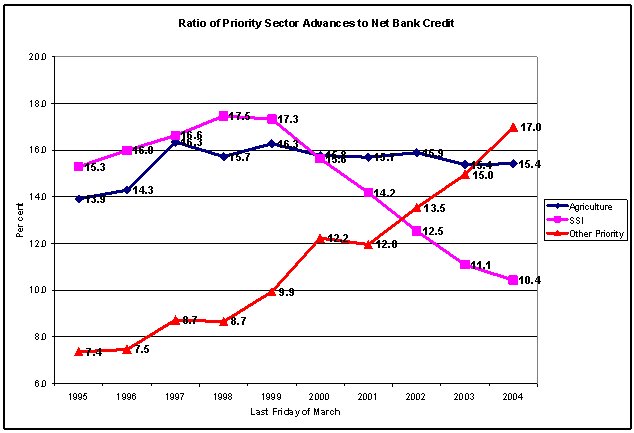
areas have been missed. Thus, during the period 2001-04,
the total outstanding credit to the agricultural sector
extended even by public sector banks was within the
range of 15-16 per cent of NBC as against the target
of 18.0 per. Though in respect of private sector banks,
the ratio of agricultural credit to NBC increased
from 7.1 per cent to 11.8 per cent, it still was below
target.
Further with banks allowed to lend to seed and input
supplying companies or invest in RIDF bonds, the share
of direct finance to agriculture in total agricultural
credit declined from 88.2 per cent in 1995 to 71.3
percent in 2004. The share of credit for distribution
of fertilizers and other inputs which was at 2.2 per
cent in 1995 increased to 4.2 per cent in 2004 and
the share of other types of indirect finance from
4.8 per cent to 21.0 per cent. Further, credit to
the SSI sector as a percentage of NBC declined from
13.8 per cent to 8.2 per cent. Much of this credit
went to larger SSI units, as suggested by the fact
that the number of SSI accounts availing of banking
finance declined from 29.6 lakh to 18.1 lakh.
The most disconcerting trend was the sharp rise in
the role of the ''other priority sector'' in total
priority sector lending. This sector includes: loans
up to Rs. 15 lakh in rural/ semi-urban areas, urban
and metropolitan areas for construction of houses
by individuals; investment by banks in mortgage backed
securities, provided they satisfy conditions such
as their being pooled assets in respect of direct
housing loans that are eligible for priority sector
lending or are securitised loans originated by the
housing finance companies/banks; and loans to software
units with credit limit up to Rs. 1 crore. Not surprisingly,
the ratio of ''other priority sector'' lending to
net bank credit rose from 7.4 per cent in 1995 to
17.4 per cent in 2005.
All this occurred even though the priority sector
was by no means principally responsible for non performing
assets (NPAs) in the banking system. NPAs under the
priority sector accounted for 47.5 per cent of total
NPAs in 2004. Even though, this was slightly higher
than the share of the sector in total advances (44
per cent) it was by no means disturbingly disproportionate,
given the presumption that these were ''weaker'' sectors
eligible for cross-subsidisation.
In the circumstances, the RBI's decision to correct
course, especially given signs of agrarian distress
and rising SSI mortality, seems natural. Yet, for
the RBI, the constitution of the working group and
its decision to recommend persisting with and strengthening
the priority sector lending programme is indeed a
major step forward. Financial liberalisation, which
the central bank spearheads in tandem with the Ministry
of Finance, seeks to refashion India's financial structure
in directions that require the dismantling of priority
sector lending. In 1991, the early days of unthinking
''reform'', the Narasimham Committee on the Financial
System had argued that, though directed credit programmes
had extended the reach of the banking system to cover
sectors that had earlier been neglected, the use of
the banking system to support priority sectors and
weaker sections was fundamentally misplaced. That
objective the Committee felt should the remit of the
fiscal rather than the credit system. It, therefore,
recommended that directed credit programmes should
be phased out. At most, 10 per cent of aggregate credit,
as opposed to the prevailing norm of 40 per cent,
could be directed, and targeted at a priority sector
redefined to include only small and marginal farmers,
the tiny sector of industry, small business and transport
operators, village and cottage industries, rural artisans
and other weaker sections.
Given the evidence that some of these were the sectors
which received the lowest share of priority lending
even during the heydays of directed lending, such
targeting was a prescription for dismantling the system.
That was understandable within the Narasimham framework,
which saw directed credit as unjustified. But ground
realities prevented the implementation of the Narasimham
recommendations. And changed economic and political
conditions have now forced the RBI to revisit the
implementation of the programme.
In fact, the working group starts by once again posing
the question as to whether such credit is needed at
all. Thankfully, its answer is yes. But given the
predilections of the central bank, the justification
provided for that answer is weak and even contrary.
There are two levels at which the justification can
rest. The first is on grounds of equity alone. All
sectors must get a fair share of credit, however 'fair'
be defined. It is clearly on this ground that the
working group advances its case for persisting with
directed credit. To quote the working group's draft
report: ''Even after 36 years of priority sector lending
prescriptions, it is observed that certain important
sectors in the economy continue to suffer from inadequate
credit flow…. As such, the need for having priority
sector prescriptions continues to exist.''
While equity is indeed a valid objective in itself,
the second and more important reason why priority
sectors are delineated and supported with directed
credit (sometimes even at lower interest rates) is
that credit concentration is inimical to balanced
development, which in the medium term keeps overall
growth below its potential. It could either result
in inadequate supplies in sectors crucial to development,
that hold back the expansion of the more ''dynamic''
ones; it could limit the expansion of incomes and
the market and therefore of production.
For example, because of differentials in profitability,
the allocation of investment may not be in keeping
with that required to ensure a certain profile of
the pattern of production, needed to raise the rate
of saving and investment as emphasised in India by
the Mahalanobis model. An obvious way in which this
happens is through inadequate investments in the infrastructural
sector characterised most often by lumpy investments,
long gestation lags, higher risk and lower profit.
Given the ''external benefits'' associated with such
industries, inadequate investments in infrastructure
would obviously constrain the rate of growth. Overall,
the private-profit driven allocation of credit for
investment could aggravate the inherent tendency in
markets to direct credit to non-priority and import-intensive
but more profitable sectors, to concentrate investment
funds in the hands of a few large players and direct
savings to already well-developed centres of economic
activity.
Finally, even in developing countries which choose
a mercantilist strategy of growth based on the rapid
acquisition of larger shares of segments of the world
market for manufactures, the government must ensure
an adequate flow of cheap credit to chosen firms.
This needs to be done so that they can make investments
in frontline technologies and internationally competitive
scales of production and would have the wherewithal
to survive during the long period when they build
goodwill in the market.
It is for these reasons that directed credit programmes
were and continue to be adopted by late industrialising
countries. This seems to be recognised by the draft
report, inasmuch as it surveys the experience with
directed credit of a select sample of countries such
as China, Japan and South Korea. However, the emphasis
of the survey is not the importance of directed credit
in the development of these countries, but on the
problems confronted in implementing directed credit
programmes. The ''findings'' of the survey are discouraging:
risks of default on priority lending are high; targeting
results in diversion of funds to non-priority purposes;
differential interest rates increase the cost of credit
for non-preferred borrowers and distort (rather than
correct distorted) incentive structures; and, once
introduced, priority lending is difficult to dispense
with. Given this litany of problems with directed
credit, the working group's case for continuing with
priority sector lending appears to be a contradiction.
At best it appears to be the better of two evils:
iniquitous lending and distorting interventionism
in credit markets.
Fortunately, this has not prevented the working group
from recommending that the priority sector lending
programme should not just continue at the current
level, but be restructured. It calls for focus on
direct and not indirect lending to agriculture, for
rendering mediated lending to the small scale sector
or lending for creation of industrial estates is ineligible
for priority status, and for substantially reducing
the width of ''other'' priority sectors by excluding
areas like housing and consumption loans and loans
to SHGs/NGOs, the food and agro-based processing sector
and the software industry.
The recommendation to remove advances to SHGs/NGOs
and microfinance institutions from the priority category
is particularly significant. The enforced retreat
of the banks from rural credit provision under financial
liberalisation has been accompanied by an emphasis
on microcredit. But experience has shown that high
transaction costs make such credit extremely expensive
and inadequate to finance productive activity. But
now, the pressure to use the credit mechanism as an
instrument of the state is obviously strong enough
for the working group to recognise that microfinance
is no substitute for lending by the formal banking
sector. Hopefully, these conclusions and recommendations,
and not the working groups views on the experience
with directed credit worldwide, would be the basis
for future policy.
Chart
>> Click
to Enlarge

