The
nature of financial integration of developing countries
with their developed counterparts has been radically
transformed over the last four years. Evidence collated
by the World Bank's annual report for 2007 on Global
Development Finance, reveal a number of features of
the new scenario that have far-reaching implications.
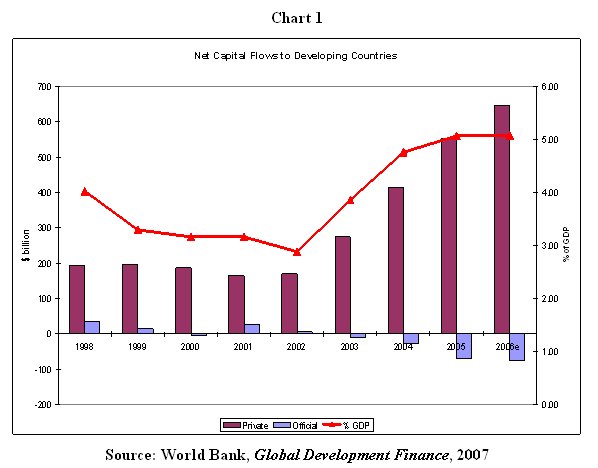
The first of these is an acceleration of financial
flows to developing countries (Chart 1) precisely
during the years when as a group they have been characterised
by rising surpluses on their current account. Total
flows touched a record estimated 600 billion in 2006,
having risen by 19 per cent on top of an average growth
of 40 per cent during the three previous years. Relative
to the GDP of these countries, total flows, at 5.1
per cent, are at levels they touched at the time of
the East Asian financial crisis in 1997.
Chart
1 >> Click
to Enlarge
A second feature is the acceleration of the long term
tendency for private flows to dominate over official
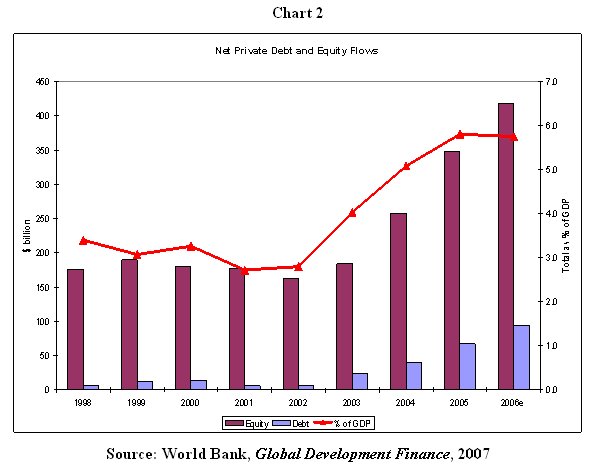
(bilateral and multilateral) flows. Private debt and
equity inflows, which had risen by 50 per cent a year
over the three years ending 2005, increased a further
17 per cent in 2006 to touch a record $647 billion
(Chart 2). On the other hand net official lending
has in fact declined over the last two years. One
factor accounting for this is the failure of the G-7
to match promises of a substantial hike in aid disbursements
beyond what the retirement of the debt of few heavily
indebted poor countries ensures. The other is that
the more developed among the developing countries
have chose to make advance repayments of debt owed
to official creditors, especially the IMF and the
World Bank. Overall, principal repayments to official
creditors exceeded disbursements by $70 billion in
2005 and $75 billion in 2006. In the event there has
been a reverse flow of capital to the World Bank and
the IMF, which is threatening the viability and influence
of these institutions, especially the latter. However,
the increase in private flows has more than matched
the reverse flows to official creditors.
Chart
2 >> Click
to Enlarge
The third feature is that the dominance of private
flows has meant that both equity and debt flows to
developing countries have risen rapidly, with the
surge being greater in the case of the former. Net
private debt and equity flows to developing countries
have risen from a little less that $170 billion in
2002 to close to $647 billion in 2006, an almost four-fold
increase over a four-year period. While net private
equity flows, that rose from $163 billion to $419
billion dominated the surge, net private debt flows
too increased rapidly. Bond issues rose from $10.4
billion to $49.3 billion and borrowing from international
banks from $2.3 billion to a huge $112.2 billion.
What is more, net short-term debt, outflows of which
tend to trigger financial crises, has risen from around
half a billion in 2002 to $72 billion in 2006.
The fourth feature, which is a corollary of these
developments, is that there is a high degree of concentration
of flows to developing countries, implying excess
exposure in a few countries. Ten countries (out of
135) accounted for 60 per cent of all borrowing during
2002-04, and that proportion has risen subsequently
to touch three-fourths in 2006. In the portfolio equity
market, flows to developing countries were directed
at acquiring a share in equity either through the
secondary market or by buying into initial public
offers (IPOs). IPOs dominated in 2006, accounting
for $53 billion of the $96 billion inflow. But here
too there were signs of concentration. Four of the
10 largest IPOs were by Chinese companies, accounting
for two-thirds of total IPO value. Another 3 of those
10 were by Russian companies, accounting for an additional
22 per cent of IPO value.
A fifth feature is that despite this rapid rise in
developing country exposure, with that exposure being
excessively concentrated in a few countries, the market
is still overtly optimistic. Ratings upgrades dominate
downgrades in the bond market. And bond market spreads
are at unusual lows. This optimism indicates that
risk assessments are pro-cyclical, underestimating
risk when investments are booming, and overestimating
risks when markets turn downwards. But two consequences
are the herding of investors in developing country
markets and their willingness to invest in a larger
volume of money in risky, unrated instruments.
Finally, the rapid rise in capital flows to developing
countries at a time when many of them are recording
large current account surpluses has substantially
increased their foreign exchange reserves and triggered
a flow of capital out of developing countries. This
outflow takes three forms: (i) investment of reserves
in safe and low-return instruments such as US Treasury
Bills; (ii) financing of asset acquisition to support
the growing presence of leading developing country
firms in global commodity markets; and (iii) financial
investments in and lending to other developing countries,
resulting in the South-South flow of capital. These
trends together suggest that developing countries
are still largely restricted to the low return or
high risk segments of global capital flow. This is
the cost they bear to meet the requirements of ensuring
balance in the global balance of payments.
These features of the current global financial scenario
can be interpreted in two ways. One is in the direction
taken by the World Bank. It admits, on the one hand,
that ''the probability of a turn in the credit cycle''
has risen and that a ''key challenge facing developing
countries is to manage the transition by taking pre-emptive
measures aimed at lessening the risk of a sharp, unexpected
reversal in capital flows''. On the other, it downplays
the dangers involved by arguing that the surge in
capital flows ''speaks well for the resiliency of
developing economies and for the ability of international
financial markets to manage risks.''
An alternative view would be that many emerging market
economies that attract a disproportionate share of
these capital flows, are fast approaching a situation
where they are vulnerable to financial crises, with
the current scenario incorporating features that could
make these crises more intense. What is more, it appears
that prudential norms, risk management techniques
and disclosure requirements put in place as part of
the so-called ''new international financial architecture''
seem inadequate to foreclose a build up of this kind.
This is not surprising, since garnering large and
quick profits rather than minimising risks seems to
be the dominant requirement of financial institutions
from the developed countries.
The current situation is the inevitable result of
expanding the space for financial capital through
dilution or elimination of regulation. Financial liberalisation
has ensured that since the late 1970s, the newly discovered
''emerging markets'' among developing countries have
been the new frontier for profiteering by global financial
institutions. Awash with the liquidity derived from
the surpluses earned by oil exporters and the savings
accumulated by the generation of baby-boomers in the
West, banks, investment funds and pension funds were
looking to new avenues for lucrative investments.
The role of financial intermediaries was one of dressing
up developing countries that were hitherto ''untouchables''
as lucrative destinations for financial capital. And
financial innovation consisted in not just identifying
instruments that could carry such investments, but
derivatives that could help hedge against the risk
associated with rushing into uncharted territory.
The process began when developing countries were still
reeling under the effects of declining non-fuel commodity
prices and rising oil prices, which had left gaping
holes in the current account of their balance of payments.
The new found interest of global finance offered developing
country governments an opportunity to finance that
gap, even if it meant offering high returns to foreign
financial investors. It was this conflation of interests
of developing country governments and financial institutions
from the developed countries that led up to the debt
crisis of the 1980s and the financial crises of the
1990s, including those that began with the East Asian
crises in 1997.
One consequence of the 1997 crisis was a sharp decline
in lending to developing countries. But this did not
mean a decline in capital flows. Rather, encouraged
by the post-crisis deflation in asset prices in emerging
markets and the sharp devaluation of their currencies,
foreign direct investment kept flowing into developing
countries to acquire assets at rock bottom prices
when measured in hard currencies. While net debt flows
to developing countries declined from $53.1 billion
in 1998 to just $1.2 billion in 2000, net FDI flows
remained more or less stable at around $170 billion
a year.
Since 2002, when growth accelerated or remained high
in China and India and commodity prices rose sharply
in the case of oil and metals and moderately in the
case of agriculture, this lull in capital flows has
given way to a surge. Besides the features noted above,
three kinds of developments have accompanied this
surge. First, the growing importance of unregulated
hedge funds looking for abnormal returns in portfolio
equity markets, which renders activity in those markets
highly speculative and opaque. Second, the rapid increase
in investments by ''private equity'' firms – investing
largely in unlisted equity - in corporations in developing
countries. The size of each of these investments is
such that they are identified as foreign ''direct''
investments, even though their objective is speculative.
The evidence on the controversial role played by these
firms in the developed countries indicates that their
activity too is extremely opaque. Third, the revival
once again of the global market for developing country
debt, driven this time by private corporate borrowing
in the syndicated loan market. Since this new surge
in credit rides on a wave of securitisation that transfers
the risk associated with such lending to pension and
mutual funds among others, accumulating risk does
not serve as a deterrent on banks creating such credit.
There are a number of implications of these tendencies.
To start with, the risk associated with the current
surge in capital flows can be and is much greater
than was true during previous episodes involving a
similar surge. Moreover, the surge is accompanied
by the growing acquisition of assets in developing
countries outside the stock market with objectives
that are largely speculative, so that a sell-off,
if it occurs, would be far more widespread. And the
persistence of the herd instinct has meant that the
surge in fixed and portfolio investment flows has
resulted in a revival of credit flows that is unbridled
since it is accompanied by risk-mitigation techniques
that transfer risk to those who are least equipped
to assess them. Unfortunately, all of this occurs
in an environment in which the target of both investment
and debt flows is the private sector, which makes
it difficult for governments that have liberalised
financial regulation to control such flows. In sum,
the risks associated with the current surge in capital
flows are far greater than emerges from the World
Bank's rather sanguine assessment of the possible
fall-out of the ongoing transformation of global financial
flows. A turn in the investment cycle, with far-reaching
implications, is real and imminent.

