Stories
abound of India's growing presence as a global player.
Much has been written about the country's success
in the export of software and IT-enabled services,
about the successes of the Indian Diaspora and of
the global expansion, through new investments and
acquisitions, of India's corporations and business
groups. But till recently there has been one disappointing
indicator: the inadequate presence of 'Made in India'
products in the global market for manufactures; in
fact, in the market for goods as opposed to services.
This was a shortcoming in itself, but more so because
an expanding global presence in the market for manufactures
was an explicit objective of the programme of neoliberal
reform launched a decade-and-a-half ago.
Liberalisation was expected to boost commodity exports
in two principal ways, among many. First, exposure
to international competition as a result of trade
liberalisation was expected to restructure economic
activity in ways that would enhance exports. The share
in total production by domestic firms of goods in
which India had a competitive advantage globally was
expected to rise. And goods actually produced would
be delivered through technologies and processes that
were internationally competitive. Second, international
firms were expected to seek out India as a location
for world market production, making India one more
hub for manufactured exports by international firms.
If China could do it, so could India, it was argued,
so long as we were more open. But with a decade-and-a-half
of continuous liberalisation behind us, these expectations
remain largely unrealised. There were individual years
of rapid export growth, but the long-term trend is
disappointing.
Yet, more recently, there is talk that as an intrepid
explorer of the global economic space, India has begun
to find its place in the global market for manufactures,
as well. Even if belatedly, it is argued, India has
added this too to its list of economic successes.
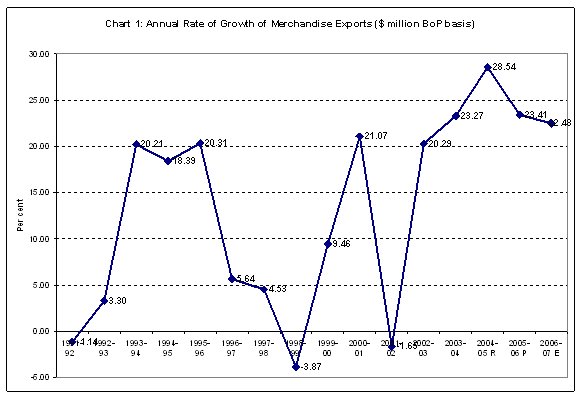
Such optimism is not without basis, even if occasionally
exaggerated. It stems from the fact that the last
five financial years have been characterised by rates
of growth in the dollar value of merchandise exports
(balance of payments basis) in excess of twenty per
cent per annum (Chart 1). Though there was a short
period in the early 1990s and a single year thereafter
when this had occurred in the past, this is the first
sign of a sustained rate of growth of India's merchandise
exports since the beginning of reform.
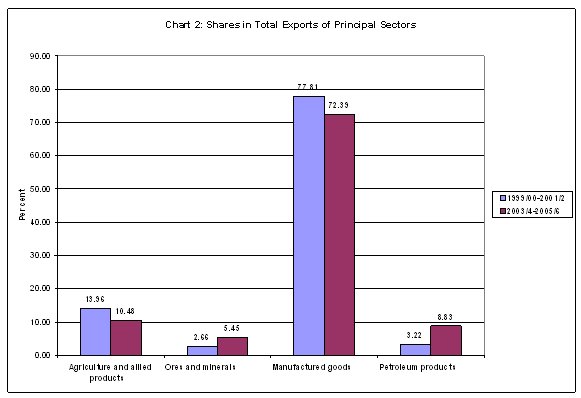
This shift to what appears to be a higher growth trajectory
is also accompanied by a shift in the composition
of overall merchandise trade. But this does not seem
to be in the expected direction. Comparing performance
on average between the three-year period ending financial
year 2000-01 and that ending 2005-06, the shift in
fact seems to be away from manufacturing and agriculture
towards ores and minerals and petroleum products.
The increase in share of ores and minerals is explained
by enhanced demand for commodities like iron ore from
countries such as China. The shift is indicative of
changes in international demand conditions rather
than major changes in India's competitive position.
On the other hand, the exports of petroleum possibly
reflect the volume and structure of India's refinery
capacity, with India remaining a large net importer
of petroleum, oil and lubricants. This is not to say
that the exports of manufactures are not growing.
But changes in the overall composition of India's
exports during the years of export recovery do not
point to a major contribution by manufacturing to
those changes, and therefore to any significant shift
in India's competitive position in manufactured exports.
Chart
1 >> Click
to Enlarge
A
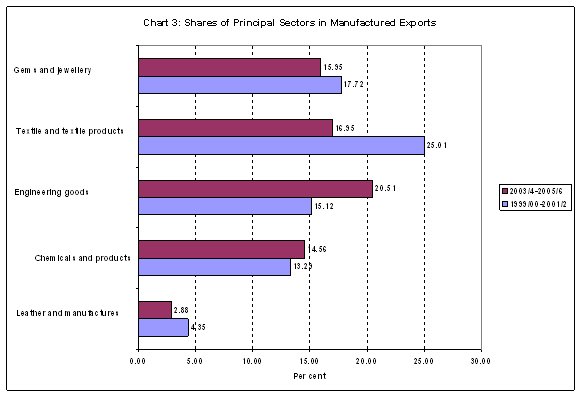
more significant change is in the composition of India's
manufactured exports itself (Chart 3). In the short
period under review, the share of India's traditional
manufactured exports such as textiles, gems and jewellery
and leather in the total exports of manufactures has
declined, while that of chemicals has risen modestly
and that of engineering goods quite sharply. This
is the feature that gets captured in anecdotes of
India's success in global markets in areas like automobile
parts and chemicals and pharmaceuticals. It points
to a diversification of manufactured exports into
new areas and markets. But that diversification has
not helped export growth to an extent where it has
become the driving force in India's moderate export
success.
This picture of qualified and limited success is strengthened
if we examine more disaggregated evidence of merchandise
trade available from the Directorate of Commercial
Intelligences and Statistics (DGCIS) for the first
seven months (Aptil-October) of financial year 2006-07
and compare it with the performance during the corresponding
period of the previous year. This data too points
to a creditable 25 per cent annual increase in India's
merchandise exports in dollar terms.
Chart
2 >> Click
to Enlarge
But the growth in exports appears to be extremely
concentrated. If we take the top ten fastest growing
exports between these two periods, we find that they
account for as much as 55 per cent of the increase
in overall merchandise exports. This in itself should
give no cause for concern. Success in a few areas
of competitive advantage is still success. But the
difficulty lies in the nature of this commodity set.
In order of rank in terms of export growth rates,
it consists of sugar, molasses, non-ferrous metals,
raw cotton, man-made staple fibre, groundnut, petroleum
crude, aluminium, dyes and primary and semi-finished
iron and steel.
In some of these cases such as sugar, molasses, raw
cotton and groundnut, they could reflect specific
international conditions and may not be sustainable.
In others, such as non-ferrous metals, aluminium,
staple fibre, dyes and steel they represent India's
competitiveness at the lower end of the global value
chain. But with the global market booming because
of demand from countries like China, exports and profits
are growing.
In sum, there is some success here, but nowhere near
the expectations that had been generated by the advocates
of liberalisation. India is still to encash the competitive
capabilities it built in the commodity producing sectors
during the import substitution years. One consequence
is that after many years of economic reform India
is still plagued with a large deficit in its merchandise
trade account, with imports growing much faster than
exports.
This however has not mattered as much as it should
for two reasons. First, the runaway success the country
has recorded in the new area of trade in services,
especially software and IT-enabled services, has helped
boost foreign exchange earning. Second, the continuing
ability of Indian workers to mine available opportunities
in the global labour market, has delivered large remittances
into the country through the liberalisation years.
Together these flows of foreign exchange have helped
financed a large portion of the deficit in the merchandise
trade account. This has kept the current account deficit
on the balance of payments at reasonable levels and
even delivered surpluses in a couple of years.
Chart
3 >> Click
to Enlarge
But these developments have a downside. Success in
services and high growth without balance of payments
difficulties has made India, with its large domestic
market and overtly favourable policies, an attractive
destination for foreign investors. The net result
has been the large flow of capital into the country
and signs of a growing inability of the Reserve Bank
of India (RBI) to intervene in India's liberalised
foreign exchange markets to limit the appreciation
of the rupee. An appreciating rupee renders India's
exports more expensive and reduces the possibility
that India would improve on its export success at
the lower end of the global commodity value chain.
The possibility that India would enter higher-end
segments with a higher proportion of final value added
being generated within its own geographical boundaries
is weakening.
Bigger Indian firms seem to be seeking a way out of
this conundrum with new strategies involving acquisitions
abroad. Flush with foreign reserves, the RBI has relaxed
regulation of capital account transactions and increased
the access of Indians and Indian firms to foreign
exchange both domestically as well as from abroad.
This has permitted the new experiment. Rather than
wait to built domestic capacities at the top end of
the value chain that are internationally competitive,
firms are seeking to buy into capacities and brands
abroad. This would allow them to do the lower end
processing in India, export the intermediate to acquired
facilities abroad for further processing and then
deliver the output to global markets. This seems to
explain acquisitions such as that of Corus by the
Tata group, which seeks to leverage the latter's access
to quality iron ore and basic steel processing facilities.
These intermediate products would be delivered to
Corus at low cost to be processed for end-product
markets that Corus has access to. India firms are,
it appears, seeking to bypass a phase in development
with the aid of finance that facilitates acquisition.
This is obviously a high risk strategy. When the global
system is flush with liquidity acquisitions are the
norm as the ongoing mergers and acquisitions wave
across the world proves. Firm values are therefore
at their peak making acquisitions costly. Integrating
or synchronising the activities of existing and acquired
units is a problem even within a country and for firms
with experience across vertically integrated segments
of an industry. They could prove a nightmare for firms
without such experience attempting it globally. And
betting on brands available for sale is often a gamble.
The strategy can easily fail.
It is yet to be seen, therefore, if such strategies
are a substitute, however partial, for making India
a manufacturing hub for global markets. It would not
in one obvious sense. The products concerned may be
made by firms controlled by Indians, resident or otherwise,
but they would not be Made in India. And experience
elsewhere has shown that what is good for a country's
corporations need not necessarily be good for the
country. But, pursuing a strategy which makes the
country an export hub of one kind or another may not
be either.

