Banking
in India is changing face, looking to the mortgage
market and personal debt as the route to profit. Having
been permitted, in fact encouraged, to chase profits
in markets that were restricted earlier and with instruments
that were rare or non-existent, banks are choosing
to change their portfolios rather sharply. This occurs
at a time when the appetite and ability of banks to
create credit has increased significantly.
The ability of banks to lend has expanded because
the Indian economy is awash with liquidity as a result
of massive inflows of foreign capital. Excess liquidity
has encouraged them to seek out potential borrowers
and persuade them to increase their portfolio of debt.
In the event, at a time when GDP growth has been accelerating,
credit has grown at an even faster rate. According
to the Reserve Bank of India’s Report on Currency
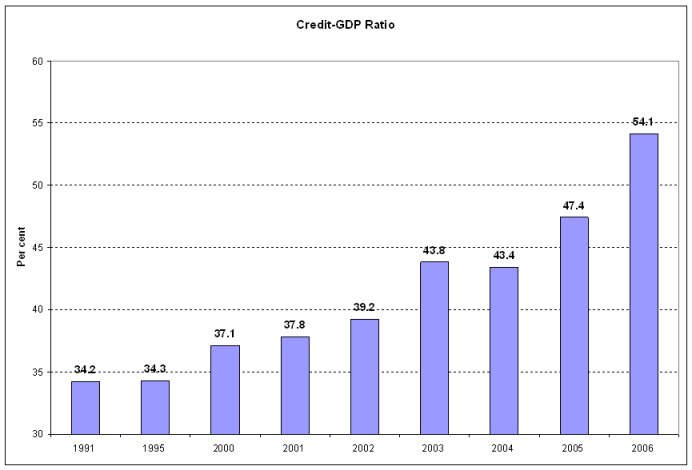
and Finance 2006-07, the credit-GDP ratio in the country
which rose from 34.2 per cent in 1991 (when the reforms
began) to 43.4 per cent in 2004, has risen to 54.1
per cent over the subsequent two years. Banks are
at the centre of this credit splurge accounting for
close to 80 per cent of credit provided by the end
of March 2006.
It could be argued that since GDP is growing rapidly,
credit growth would be high as well. But the rise
in the credit to GDP ratio indicates that there is
more to the matter. Credit is growing even faster
than warranted by higher growth. This appears to be
true of all the major sectors-agriculture, industry
and services-of the economy, in each of which the
rate of growth of credit has been in excess of the
rate of growth of sectoral GDP. As a result "credit
intensity", defined as the ratio of credit offtake
to sectoral GDP, has risen in all of these sectors.
Chart
1 >> Click
to Enlarge
But focusing on the relative rate of growth of credit
with respect to GDP in individual sectors can be misleading.
The trend may be the result of the slow growth of
production rather than a fast growth of credit, as
appears true in an area like agriculture where GDP
growth has been poor over a long period of time. A
better index, therefore, would be the share of different
sectors in outstanding credit, which would show whether
one or more sectors are responsible for the spike
in credit growth.
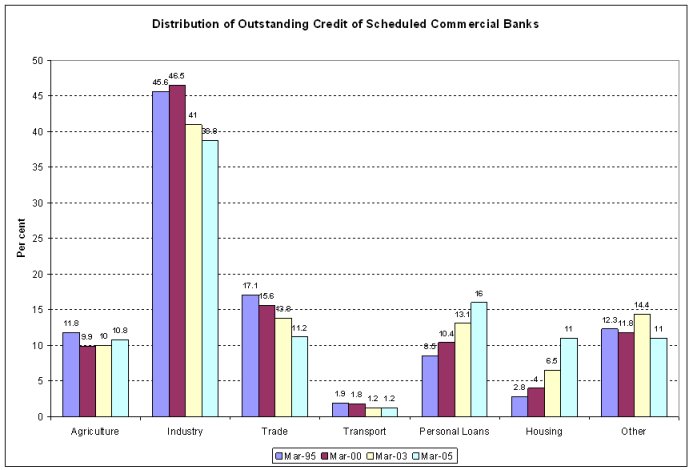
Thus, if we examine the share of outstanding credit
of the scheduled commercial banks accruing to different
categories of borrowers, we find that the share of
agriculture fell sharply from 16 per cent at the end
of March 1990 to 10 per cent at the end of March 2003,
with the figure rising marginally to 10.8 per cent
by end-March 2005. The trend seems to be the same
in industry where the decline has been continuous
from 48.7 to 38.8 between 1990 and 2005. In trade
too, the decline has been sharp from 17.1 in 1995
to 11.2 per cent in 2005.
These trends point to a diversification of bank credit
away from the commodity producing sectors and even
trade. The loss in share of these sectors seems to
be almost completely counterbalanced by loans to individuals
and professionals (Personal Loans and Professional
Services), whose share rose from 9.4 per cent to 16.8
per cent between end-March 1990 and end-March 2002,
and then shot up to 27 per cent by end-March 2005.
This is the direction in which credit is moving, and
these are the sectors accounting for a substantial
part of excess credit growth.
Chart
2 >> Click
to Enlarge
While a number of sub-categories such as loans for
purchases of automobiles and consumer durables, especially
the former, have gained in terms of growth in credit
provision, there is one sector that has absorbed the
bulk of the increase even here: loans for housing.
The share of housing loans in scheduled bank credit
rose from 2.4 per cent in 1990 to 5 per cent in 2002
and then to 11 per cent by 2005.
From the point of view of the scheduled banks’ lending
portfolio this has implied two outcomes. First, the
exposure of the banking sector to the retail loan
segment has increased substantially. The share of
personal loans in total bank credit has almost doubled
in recent years rising from 12.2 per cent in 2001
to 22.2 per cent in 2005. Second, retail loan exposure
has been concentrated in housing finance, with housing
loans accounting for 53 per cent of retail loans in
2005.
One factor accounting for these outcomes, noted by
the RBI’s Report on Currency and Finance, is the decline
in demand for bank credit from industry. With profits
soaring in recent times, retained profits and reserves
have proven to be major sources of finance for the
corporate sector. Three among non-bank sources of
finance for industry have registered significant or
dramatic increases in recent years. To start with,
resources raised through new capital issues increased
from Rs. 2422 crore in 2003-04 to Rs.13,781 crore
in 2005-06. Reports have it that sums raised through
this route would exceed Rs.1,00,000 crore in 2007
(Business Standard, 23 June 2007). Second, the contribution
of retained earnings rose from Rs.15,645 crore to
an estimated Rs.48,402 crore over these three years.
And, finally, borrowing from abroad, rose from Rs.16,098
crore to Rs.45,708 crore. In sum, own or cheaper sources
of domestic finance have substituted for borrowing
in aggregate corporate finance. But to the extent
that firms’ appetite for investment has increased,
necessitating borrowing for investment, they prefer
to borrow from cheaper sources abroad than from the
domestic banking system.
Deprived of credit demand from their conventional
blue chip clients, banks would have been forced to
turn elsewhere. The retail market, with a preference
for housing finance, seems to have been the chosen
option. But it would be wrong to presume that banks
turned to the retail segment only because of the "push"
out of the corporate credit market. Loans to the retail
segment are lucrative. Since they are distributed
across a large number of borrowers the risks involved
in such lending are hedged. Lending to the housing
sector creates its own collateral in the form of the
mortgaged property. And, finally, banks in India,
like their counterparts in the developed countries,
are increasingly securitising retail debt. Mortgage
loans to different segments are bundled together and
securitised, with the securities thus created being
sold to financial institutions, insurance companies
and mutual funds. Credit created by the banks disappears
from their balance sheets and appears in the investment
portfolios of investors and funds. This permits banks
to transfer some of the risk associated with retail
lending, reducing the risk they carry as a result
of their high exposure to these markets.
The craving for housing finance created by these features
is also resulting in a shift away from what are considered
safe investments. For example, in the latter half
of the 1990s banks invested in government securities
to an extent far in excess of that needed to meet
the liquidity stipulations set by the RBI through
its statutory liquidity ratio (SLR) guidelines. But
more recently banks have been unwinding their excess
holdings of SLR securities, to generate resources
that can help finance incremental credit. Banks have
also shown a tendency to resort to overseas borrowing
to augment capital needed to finance the demand for
credit from the retail market.
But with exposure growing rapidly in a single area,
the risks are now clearly rising. While lending to
home owners may be a more secure form of credit, for
the reasons noted above, a rapid increase in such
credit inevitably involves features that spell risk.
Finding a growing number of new borrowers to ensure
credit offtake inevitably requires relaxing income
criteria for those applying for loans or lending to
those whose income stream is not guaranteed or secure.
It may also involve lending without adequate scrutiny
of income documents. The result would be an increase
in the proportion of risky borrowers in a situation
of rising credit provision and increased exposure
to the housing market. Defaults and foreclosures could
increase with adverse consequences for bank profitability
and even viability.
This possible outcome can be worsened by the effects
of speculation. An immediate consequence of a credit-financed
spike in housing acquisitions is a rise in real estate
prices. India has been experiencing such a rise in
recent years, which in turn has encouraged real estate
speculation. The implies that many borrowers are not
financing homes they plan to live in, but those they
plan to sell for profit at an appropriate time. If
this leads to a glut in housing in certain brackets,
or if changes, such as an increase in interest rates,
affect speculators’ expectations adversely, a collapse
of the housing boom could ensue. Those who resorted
to credit hoping to close their deals well before
maturity might find it difficult to meet their credit
obligations, and banks may find themselves saddled
with foreclosed property worth much less in the market
than the loan provided. What is more, with securitisation
having gained ground in India, the ripple effects
of this would be felt in other segments of the financial
sector to which the risk has been transferred.
Recognising these risks the central bank has been
warning banks against increasing their exposure to
the housing market any further and requiring them
to be more stringent when scrutinising loan applications.
Whether banks are heeding these warnings is unclear.
There are signs of a dampening of the growth of housing
credit in recent months; but that could be more the
result of the recent hardening of interest rates rather
than of increased bank caution. Banks need to lend
when loaded with deposits; and that can be a problem
if prime borrowers in the commodity-producing sectors,
industrial firms, are reluctant to turn to the banks
for credit. But the recent trends in Indian banking
suggest that they have gone even further than warranted
by this development. It is time to hold back. And
it is also time to think of ways of diversifying portfolios,
even if returns are not as attractive.

