Everybody
learns at their pace. It is not surprising therefore
that it has taken Finance Minister P. Chidambaram
an unduly long time to realize that large capital
inflows into India can adversely affect growth and
the price level. More than three years after India
became the target of an unprecedented surge in foreign
investment inflows, he has finally declared, when
tabling in Parliament the Mid-Year Review of the Indian
economy, that this was a cause for concern.
This admission does point to a major change in the
Finance Minister’s earlier understanding that capital
inflows were not just benign but unquestionably beneficial.
But on that understanding, he has stretched himself
and the nation’s budget to attract such flows. The
most telling instance of such an effort was his decision
in 2004, "to abolish the tax on long term capital
gains from securities transactions". By doing
this he made the tax regime applicable to stock market
investments in India much more favourable than in
most other developing and even developed economies.
Subsequently, when FII inflows were resulting in an
unprecedented boom in capital markets that many observers
felt was not warranted by fundamentals, he sought
to assuage such fears by arguing that better corporate
performance meant that price-earnings ratios in India
were still below acceptable levels. Foreign institutional
investors were coming to India, he argued, because
the economy was doing well under his leadership. Finally,
when the Reserve Bank of India was expressing concern
over these flows and calling for moves to stop inflows
through speculative channels such as participatory
notes (PNs), the ministry he heads not merely disagreed
but sought to silence spokespersons from the central
bank who expressed such views.
Thus, experience seems to have taught the Finance
Minister an important lesson, resulting in a significant
change in his view on the benign and beneficial nature
of capital inflows. But in this case the lesson learnt
may be too little and too late. Too little, because
the Finance Minister does not seems to have fully
understood the problems that the capital surge has
created and is still creating. Too late, because the
Finance Minister looks unwilling to face the consequences
of actions aimed at slowing, let alone arresting,
capital inflows. Foreign capital flows have the quality
that the more you have of them, the more difficult
it is to say that you do not want any more. Choosing
to say no does not just close the tap on new flows
but triggers a drain of capital that has already come
in. The larger is the stock of past inflows, the more
damaging this may be, necessitating stronger action.
And the Finance Minister’s past actions and current
perceptions, do not suggest that this government would
be willing to make the necessary moves. In the event
capital would continue to flow in till such time that
the foreign investors themselves choose to turn their
backs on this country. And if and when they do, the
damage can be severe.
The Mid-Year Review tabled by the Finance Minister
explains why he now sees capital flows as a potential
constraint on macroeconomic management and growth.
The problem is not that India has with a liberal financial
policy allowed itself to be the target of unprecedented
capital inflows that the country does not need to
finance its balance of payments. Rather, to quote
the review, the problem is that: "The economy’s
capacity to absorb capital inflows … has not risen
as fast as the inflows." Needless to say, this
inability to "absorb" in the context of
large inflows, results in an excess supply of foreign
exchange that puts pressure on the rupee in the form
of a tendency to appreciate. In the event, the rupee
has appreciated against the dollar by 15.1 per cent
over the year ended October 2007 and by close to 10
per cent between April 3 and November 20 this year.
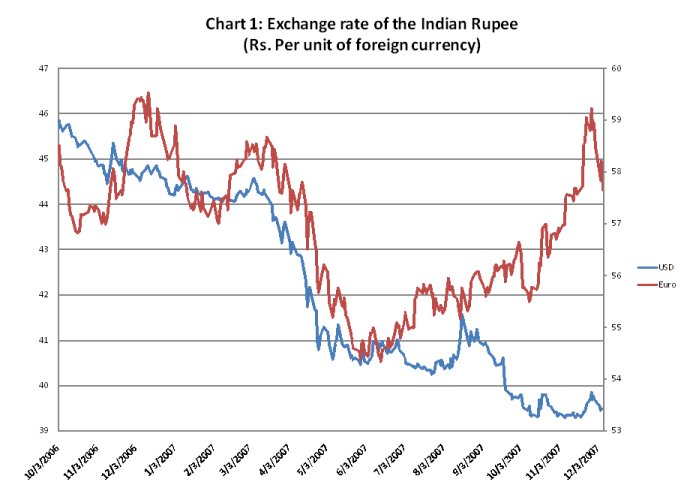
Chart
1 >> Click
to Enlarge
An appreciation of that magnitude, by raising the
dollar value of India’s exports, would adversely affect
exports, since exporters would not be able to reduce
margins and prices to that extent. It gives little
comfort that the rupee has not appreciated as much
vis-à-vis other currencies such as the euro,
since the dollar is the currency in which much of
India’s trade is denominated. Forced by exporters
to recognize the effects that appreciation is having
on the exporting industries, the Review admits that
this could "moderate" growth and lead to
"temporary" job losses in some of India’s
major export industries such as textiles, handicrafts
and leather.
This occurs despite the efforts of the government
and the central bank to stall rupee appreciation through
means that have their own side effects. The Reserve
Bank of India (RBI) has consistently sought to deal
with the problem of an excess supply of foreign exchange
by buying up foreign currency in the market. But this
results in the injection of rupees into the system
and increases money supply by more than what the central
bank has targeted. To mop up the excess rupees the
Finance Ministry has allowed the RBI, under the Market
Stabilization Scheme, to issue government bonds, the
interest on which is paid out of the budget. This
is an additional burden that the Finance Ministry
has to bear. The Budget for 2007-08 had provided for
an outgo of Rs. 3,700 crore on this account. But the
Mid-Year Review estimates that interest payments on
bonds issued for this purpose would amount to Rs.
8,200 crore, necessitating a supplementary demand
of Rs. 4,500 crore. Even more money may have to be
allocated for the purpose before the next financial
year.
Already burdened with a large public debt and a huge
interest burden and committed to meeting the irrational
targets set by the Fiscal Responsibility of Budget
Management Act, this additional commitment reduces
the government’s fiscal maneuverability substantially.
Profit inflation and high growth have no doubt helped
the government, with direct taxes growing by 40 per
cent and indirect taxes by 20 per cent during the
first quarter of this financial year (as compared
with the corresponding quarter of the previous financial
year). But expenditures have also risen rapidly, so
that the revenue deficit during the first quarter
was already near the target for the fiscal year as
a whole.
One consequence of these trends is that the government’s
ability to cover rising petroleum, fertilizer and
food subsidies has been eroded. The subsidies required
in these areas have been rising rapidly because of
the rise in petroleum and food prices in the international
market and India’s traditional dependence on petroleum
imports and more recent dependence on food imports,
especially of wheat. Subsidies rise because the government
cannot politically justify an increase in the prices
of these commodities, and would not dare raise them
in a period when crucial state elections and even
elections to parliament are not far away. On the other
hand, rising subsidies make it increasingly difficult
for the government to meet its FRBM commitments while
maintaining expenditures ate reasonable levels.
One way in which the government has sought to overcome
the problem this creates is through the financial
sleight of hand in which it issues bonds that are
deposited with oil and fertilizer companies, which
are not being permitted to raise prices to cover higher
costs. The value of the bonds covers their losses,
and they can sell the bonds in the secondary market
if they need cash. Since the government receives no
payment for these bonds which it uses to cover its
expenditures, there is no cash outgo. So the sum involved
is kept out of the revenue and fiscal deficit figures.
But these bonds do add to the liabilities of the government,
and would require large capital outflows when the
bonds mature. The government is also required to pay
the interest that is due on them, adding to the interest
burden borne by the government.
This has a number of implications. To start with,
the constraint on government spending is much greater
than is suggested by the aggregate figures on receipts.
This is bound to adversely affect capital outlays
and social expenditures. Second, strapped for funds,
the government would be less willing to compensate
exporters for rupee appreciation with explicit or
implicit subsidies. The Review derides such measures
as a short-term answer and prescribes improvements
in productivity as a lasting solution. Finally, as
the burden of continuing with the so-called "deficit-neutral"
measures to deal with subsidies increases, the government
would, political circumstances permitting, increase
prices to reduce subsidies. This would reveal the
rate of inflation warranted by the government’s policies
and the pace and pattern of growth they generate.
Thus the practice of using bonds that do not mobilize
capital but require interest payments and involve
a liability for the government is only a way postponing
problems that the government does not want to recognize
and address. The same is true of the tendency to see
the problems created by capital flows as being the
result of the inability of the country to absorb them
rather than the fall-out of an excessive inflow of
unwanted capital. A consequence of that perception
would be policies directed at encouraging "absorption"
through profligate foreign exchange use. The decision
to allow every Indian (who has the wherewithal, fo
course) to buy foreign exchange equal to $200,000
every year and use it abroad for any legal purpose
whatsoever is an obvious indication of this tendency
to encourage profligacy to increase absorption.
If successful, measures like this may reduce the excess
supply of foreign exchange in the market. But that
would not mean that the problems created by the surge
in capital flows would go away. Such flows require
payments of a return in foreign exchange. They also
involve a foreign exchange liability for the country.
This may not matter as much for a country like China
which "earns" its surplus foreign exchange.
That country currently records trade and current account
surpluses of around $250 billion in a year. On the
other hand, India incurs a trade deficit of around
$65 billion and a current account deficit of close
to $10 billion. Its surplus foreign exchange is not
earned, but reflects a liability. Opting for a foreign
exchange splurge in such a situation is to create
conditions where when foreigners choose to cash their
investments and move elsewhere, the foreign exchange
needed to meet the country’s commitments may not exist.
That implies a crisis created not because we attracted
the foreign capital that we needed, but because we
did not refuse what we did not need. That would be
the price of having a Finance Minister who is a slow
and poor learner.

