If political statements and
media headlines are adequate indicators, inflation
is emerging as India’s economic problem number one.
Given the way prices, especially of essentials in
retail markets, have been moving in recent months,
this is hardly surprising. What is surprising is that
media and political attention to a problem that has
bothered the common man for sometime now has been
rather recent.
Part of the reason for this delayed response is that
headline inflation figures offered by point-to-point
annual increases in the Wholesale Price Index (WPI)
capture trends on the ground with a substantial lag.
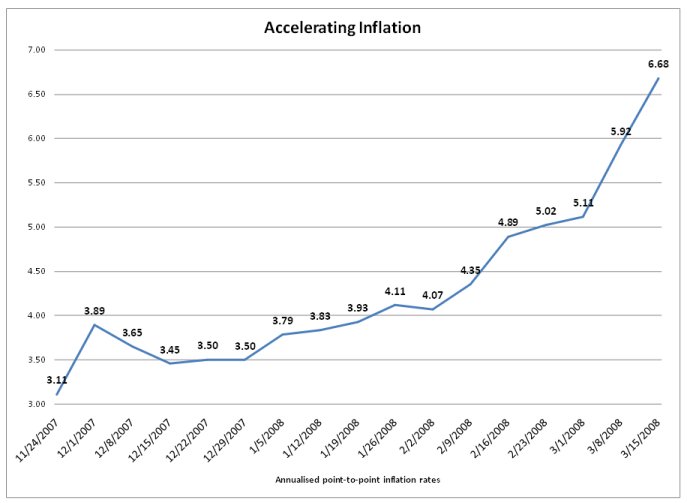
Matters came to a head when WPI-based inflation figures
relating to the week ending 15 March 2008, released
at the end of last month, indicated that the annual
rate of inflation had risen to 6.68 per cent, which
was higher than it had been for the previous 13 months.
What is more this inflation was not restricted to
a few commodities but was widely spread in terms of
its incidence. Inflation stood at 9.28 per cent in
the case of dairy products, 19.03 per cent in the
case of edible oils, 20.12 per cent in the case of
oilseeds, over 9 per cent in the case of mineral oils
and 26.86 per cent in the case of iron and steel.
The trend has continued with the annual WPI-based
inflation rate touching 7 per cent on March 22nd 2008.
The acceleration appears dramatic because going by
the WPI, even as recently as February inflation was
running low in the country, judged by historical standards
or relative to the ceiling rate of 5 per cent set
by the Reserve Bank of India. The wholesale price
index for the week ended February 2, 2008 pointed
to an annual inflation rate of just 4.07 per cent,
whereas, during the corresponding period in the previous
year annualised inflation was as high as 6.5 per cent
on a week-to-week basis. However, soon thereafter
the inflation rate started falling (even as concerns
over inflation were still being expressed), and by
October/November last year the inflation rate was
hovering around the 3 per cent level. What is being
witnessed now is a continuation of a trend that began
in December when inflation once again edged upwards
to touch 3.5 per cent in December, 4 per cent by end
January 2008, 5 per cent by late February, 6 per cent
at the end of the first week of March and then close
to 7 per cent by mid March.
It must be noted that even a 7 per cent level is by
no means high when viewed from a perspective imbued
with the tolerance for single-digit inflation levels
that characterised India in the past. But four factors
explain the almost panic-stricken response to this
rate today. First, the current level seems to be one
more step in a stairway that could quickly take inflation
to double digit levels. Second, the current level
is well above the 5 per cent mark that has been officially
declared as the acceptable ceiling rate in the wake
of fiscal and monetary reform. Third, it is accepted
that prices at the retail level are rising much faster
and inflation as measured in terms of retail prices
could be near or above double-digit levels. And, finally,
all this is occurring in a period when global inflation
is on the rise and policies of trade liberalisation
and domestic deregulation have reduced the degree
to which Indian prices are insulated from international
prices.
Of these the growing distance between retail and wholesale
prices is an important factor influencing the response.
According to figures released by the government’s
own Department of Consumer Affairs, in the last one
year, in the retail market of Delhi, the price of
groundnut oil has risen from Rs. 98 to Rs. 121 a kg,
mustard oil from Rs. 55 to Rs. 79, vanaspati from
Rs. 56 to Rs. 79, rice from Rs.15 to Rs.18, wheat
from Rs. 12 to Rs.13, atta from Rs. 13 to Rs.14, gram
from Rs. 32 to Rs. 38 and tur from Rs. 35 to Rs. 42.
In fact, figures collated by Price Monitoring Cell
of the Department of Consumer Affairs establish that
in the case of a few commodities there is huge difference
between inflation as measured by retail prices (collected
from and averaged across 18 reporting centres nationwide)
and the wholesale price index. In the case of rice,
inflation over the year ending March 15 stood at 7.88
per cent as measured by the WPI, whereas it worked
out to a huge 20.86 per cent in terms of average retail
prices. In the case of vanaspati too the inflation
rate stood at 8 and 22 per cent respectively.
These differences are bound to be reflected in the
consumer price indices for agricultural labourers
and industrial workers, which not only give greater
weight to some of the essential commodities that have
seen high rates of price inflation, but are also based
on the retail prices of these commodities. Unfortunately
the lag in the release of consumer price indices is
much greater than in the case of the WPI, the most
recent figure being for the month of February 2008.
Yet, going by the consumer price indices the annual
month-to-month rate of inflation stood at 6.38 per
in February 2008 for agricultural workers and a much
lower 4.69 per cent for industry workers. But figures
based on the March indices are likely to be much higher
given the most recent trends in prices revealed by
other sources.
A combination of domestic and international factors
is seen as responsible for this inflationary process.
A central tendency is the growing inability of the
government to use its procurement and distribution
mechanism as a means of controlling the domestic prices
of cereals and pulses. This inability stems from two
sources. The first is the failure to ensure that marketed
surpluses of these commodities grow at a fast enough
pace to match up to consumption and buffer stocking
requirements in years when demand is buoyant, as is
the case recently. The second is the liberalisation
of trade in many of these commodities that has seen
the entry of private traders including large transnational
buyers, who have cornered stocks and limited procurement
by government agencies like the Food Corporation of
India. According to estimates made by the Commission
for Agricultural Costs and Prices (CACP), the rice
stocks in the central pool as on October 1, 2008 would
be only 5.49 million tonnes, just marginally above
the buffer norm of 5.20 million tonnes. Wheat stocks
are estimated to be only 10.12 million tonnes, which
would be below the buffer norm of 11 million tonnes.
Chart
1 >> Click
to Enlarge
In the past this was not a problem because either
demand was depressed or because the government responded
to the situation by using its foreign exchange reserves
to import food and augment domestic supply. During
2006 and 2007, nearly 7.5 million tonnes of wheat
were imported by the Centre to augment buffer stocks.
However, given what has been happening to global prices,
imports have been at prices much higher than that
paid to domestic farmers, swelling the subsidy paid
to cover the difference between the import price and
the domestic sale price. Across the world, food prices,
especially those of staples like grains, have been
rising sharply in recent months. Wheat epitomises
the trend, with international prices estimated to
have risen by close to 90 per cent just during this
year.
The willingness to pay higher prices for imports even
while domestic producers are not guaranteed (with
price controls and subsidies) a remunerative return
above costs, makes it difficult to sustain the differential
between the lower domestic and higher international
prices. Stung by the criticism that the government
is paying farmers abroad more than it offers Indian
farmers, the CACP has decided to hike the minimum
support price, especially of rise. The Commission
for Agriculture Costs and Prices has recommended that
the minimum support price (MSP) for paddy be fixed
at Rs. 1,000 a quintal for the common variety and
at Rs. 1,050 a quintal for the A grade variety for
the 2008-09 kharif marketing season. This compares
with the currently prevailing MSP (including bonus)
of Rs. 745 and Rs.775 a quintal respectively. If the
recommendation is accepted, as is likely, the price
of paddy would be on par with wheat, whose support
price for the rabi season was fixed at Rs. 1,000 a
quintal as against Rs. 850 a quintal the previos year.
These changes, which reflect the desire to calibrate
domestic to international prices, are setting off
expectations of a sharp increase in the price of primary
articles. The speculation that ensues is seen as partly
triggering the current inflation in food prices.
But these developments are not necessarily driven
by a concern for India’s farmers. They are also a
consequence of the government’s decision to allow
private players, including large international firms,
a major role in domestic markets. Even though production
of wheat during 2006-07 is estimated at close to 75
million tonnes as compared with 69 million tonnes
in the previous year, procurement fell short of expectations
because the procurement price of Rs. 8.5 a kg ruled
well below market prices that ranged between Rs.10
and Rs.12 a kg. Though procurement in 2006-07 was,
at 11.1 million tonnes, higher than the 9.2 million
tonnes recorded in 2005-06, it was way below the levels
of 16.8 and 14.8 million tonnes recorded in 2003-04
and 2004-05. Figures from the Food Corporation of
India indicate that total procurement for the public
distribution system has declined from 30 per cent
of production during 2001-02 to 15 per cent in 2006-07.
This implies that with the change in market conditions
after liberalisation some degree of upward adjustment
of the floor set by procurement prices is unavoidable,
if buffer stocks are not to fall below comfort levels.
To this should be added the effects of the increase
in oil prices, of Rs. 2 a litre for petrol and Rs.
1 a litre for diesel. The government claims that this
hike is moderate and inevitable, given the sharp increase
in international oil prices. However, it is not that
there was no option. The petroleum sector contributes
more than Rs.90,000 crore by way of indirect taxes
to the Centre and Rs.60,000 crore to the States. There
is evidence of a sharp increase in direct tax collections
by the Centre. So it could have foregone a part of
its oil revenues by reducing indirect taxes and allowing
oil companies to charge more without affecting retail
prices. This is all the more important because oil
products are universal intermediates, since through
transportation and fuel costs they enter into the
costs of most other commodities. So the second- and
higher-order effects of an increase in oil prices
would be greater than in other commodities. Hence,
the government should have sought to delink domestic
oil prices from international prices through a reduction
in duties imposed on petroleum and petroleum products.
Unfortunately it has chosen not to do so.
A Gap too Wide |
(Inflation
as measured by retail and wholesale prices) |
|
Over
last 12 months |
Since beginning 2008 |
|
Retail price |
WPI |
Retail price |
WPI |
|
Rice |
20.86 |
7.88 |
3.74 |
1.95 |
|
Wheat |
4.06 |
3.97 |
3.17 |
1.39 |
|
Atta |
4.59 |
0.45 |
3.18 |
1.59 |
|
Gram |
3.95 |
3.32 |
4.41 |
3.84 |
|
Tur |
15.76 |
13.98 |
-3.55 |
1.74 |
|
Sugar |
-0.23 |
-6.87 |
5.56 |
0.59 |
|
Groundnut Oil |
14.71 |
10.11 |
2.97 |
5.86 |
|
Mustard Oil |
28.26 |
28.98 |
12.11 |
14.49 |
|
Vanaspati |
22.23 |
7.94 |
13.72 |
4.34 |
|
Potatoes |
4.12 |
29.41 |
-25.37 |
-5.41 |
|
Onions |
-27.19 |
-26.71 |
-30.63 |
-34.01 |
|
Milk |
8.07 |
9.71 |
1.90 |
1.94 |
|
Retail prices from FCAMIN Price Monitoring Cell,
averaged over 18 reporting centres |
Table
1 >> Click
to Enlarge
These are not the only areas where international factors
are influencing domestic prices trends. International,
commodities like metals have seen prices soaring because
of increased demand especially from China. Indian
firms participating in this international boom through
rising exports at soaring prices are obviously adjusting
or manipulating domestic prices upwards. This has
forced the government not only to control the rise
in prices but restrict exports. The hope that greater
integration of Indian and global markets would benefit
consumers and not producers, whereas protectionism
favours producers at the expense of consumers, has
obviously been proved wrong by circumstances.
It is in this background that the argument that in
the case of food, oil and steel domestic inflation
is being driven by international price trends has
to be judged. India was and still remains significantly
insulated from global price trends especially in the
case of commodities where exports are restricted for
various reasons. But that has been changing as a result
of the winds of liberalisation. Commodities are increasingly
being divided into those directly or indirectly catered
to by imports, and those where domestic production
caters to both domestic and global demand. In both
these cases the degree to which India has been insulated
from international trends has been reduced substantially.
That is a consequence of liberalisation and implies
that combating inflation also requires rethinking
liberalization.
Interestingly the government’s response has been exactly
the opposite. It is attempting to dampen domestic
price trends by resorting to more imports. This may
be successful in the short run in the case of commodities
like edible oils, even if at the expense of damaging
effects on the livelihoods of coconut and oilseeds
growers, for example, and adverse effects on domestic
production in these areas in the long run. But in
many other commodities import is likely to be a blunt
weapon. Unless of course it is combined with a willingness
to offer consumers of foreign products implicit subsidies
of magnitudes that are many multiples of what some
domestic consumers and producers have been offered
in the past.
Even these responses are because the current inflation
occurs in an election year and threatens to curtail
the near 9 per cent average growth rate registered
over the last five years. But there is no guarantee
of success. Fiscal year 2007-08, which has just come
to a close, appears to be an inflection point in the
current phase of post-reform growth. This is not merely
because the year saw the first significant signs of
the reversal of what was an unprecedented bull run
in stock markets. More importantly, the evidence suggests
that the government’s ability to ensure high growth
with low inflation has come to an end.

