In
India, improvement in the relative conditions faced
by women has been among the explicit goals of
government
policy, along with growth, reduction of poverty and
inequality and improved human development indicators.
Indeed, in the 1990s, the publicity given to the need
for gender equality and women’s empowerment meant
that there was a proliferation of government schemes
specifically for women.
Nevertheless, some
of the data on conditions of women indicate that things
may not have got much better for the bulk of India
women over the past decade. This is reflected even
in demographic indicators, which tend to sum up health
and living conditions at the most basic level of survival.
One
of the basic measures traditionally used as a proxy
for capturing the relative position of women in terms
of conditions of survival, is life expectancy. The
other is the sex ratio (number of females per number
of males). The recent Indian experience with both
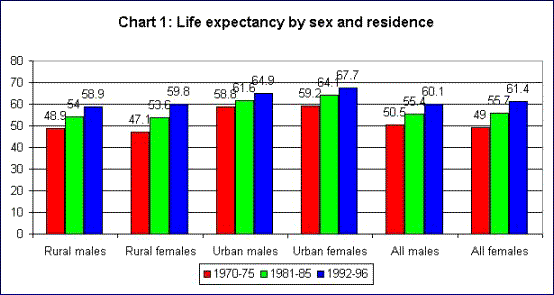
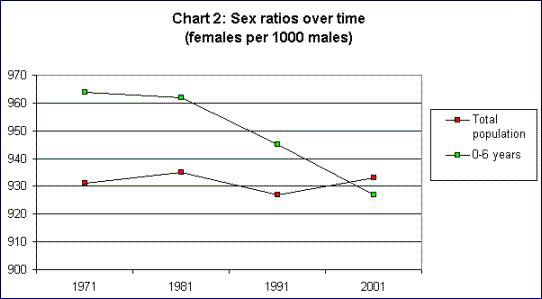
of these indicators is described in Charts 1 and 2,
and it is apparent that they suggest slightly contradictory
conclusions. It will be seen from Chart 1 that the
life expectancy of women has improved at a faster
rate than that of men, so that by the mid-1990s, women
in India had greater expectation of longevity than
men, along the standard international lines and as
predicted by biology. However, the life expectancy
differential between women and men is still below
the international norm.
Chart
1 >> Click
to Enlarge
Chart
2 >> Click
to Enlarge
Chart 2 presents a somewhat different, and more depressing,
picture. While the aggregate sex ratio for all ages
improved between 1991 and 2001, at the later period
it was still lower than the level of 1981, showing
thereby a long-term decline. And the sex ratio for
the 0-6 years age cohort has declined continuously
and quite substantially.
This is startling given that the spread of access
to modern medical techniques is supposed to ensure
birth and survival of children to a greater extent.
It points to the likely role played by the combination
of greater neglect of girl children and wider practice
of female foeticide based on modern medical techniques
to determine the sex of the foetus.
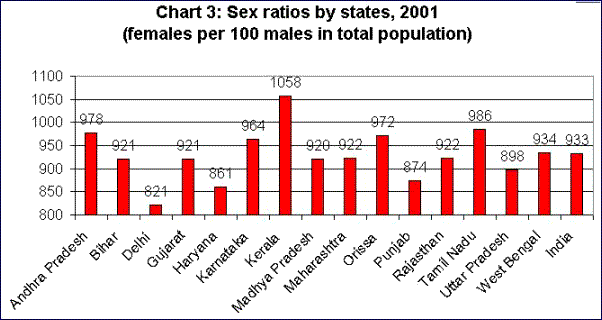
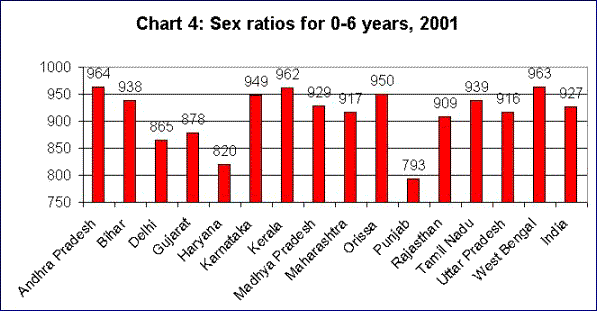
Chart 3 presents evidence
on sex ratios for the total population by state for
2001, and Chart 4 for the sex ratios for children
in the age group 0-6 years. It is clear that there
is very substantial variation across states – but
more significantly, that such variation has virtually
nothing to do with per capita income or degree of
development. The lowest sex ratio is to be found in
Delhi, which has the highest per capita income of
all states, and is the most urbanised, and among the
most developed of all states. The agriculturally developed
and high per capita income states of Punjab and Haryana
are next in terms of low sex ratio; in fact, in Punjab,
the figure drops to an appalling 793 girls per 100
boys in the age group 0-6 years.
Chart
3 >> Click
to Enlarge
Chart
4 >> Click
to Enlarge
By contrast, Kerala, which has much lower per capita
income, shows the best sex ratio at 1058 women per
1000 men, close to international norms. However, even
in Kerala the 0-6 years sex ratio is unsatisfactory,
while it is higher than the national average. In general,
several of the states that are economically less developed
(such as Andhra Pradesh, West Bengal and Tamil Nadu),
perform better than the national average by these
indicators. The complex relationship between economic
growth and the status of women, becomes very evident
here.
While
infant mortality rates have declined over time, evidence
from the Registrar General’s Sample Registration Surveys
(SRS) suggests that the rate of decline has decelerated
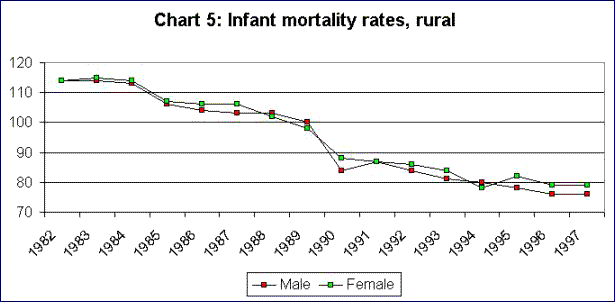
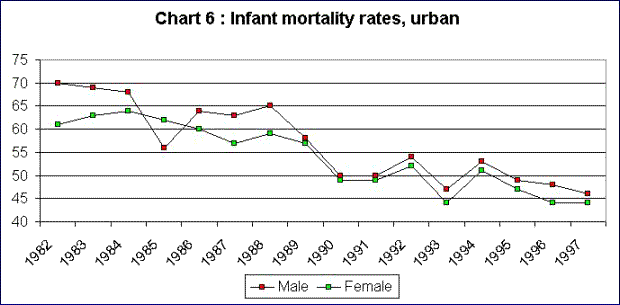
over the 1990s. This is also evident from Charts 5
and 6 which give aggregate IMRs for rural and urban
areas respectively.
Chart
5 >> Click
to Enlarge
Chart
6 >> Click
to Enlarge
The aggregate infant mortality rate for males fell
by 26 per cent between 1981 and 1991 (from 110 per
thousand to 81 per thousand) but only by 12 per cent
over the subsequent decade, to 71 per thousand. The
deceleration in infant mortality among girls over
the two decades was even sharper, from 27 per cent
to 10 per cent, such that the female IMR was 72 per
thousand in 2001. Of course this conceals the extent
of female foeticide, which is likely (if anything)
to have brought down female IMRs.
Some states have very high female IMRs, ranging from
96.9 per thousand in Orissa to 81.4 per thousand in
Haryana in 1998-99. The female IMR in Madhya Pradesh
in that year was as high as 101.5 per thousand. What
is even more disturbing is that in the recent past,
there is evidence of rising IMRs in several
states, which reverses the long run trend of decline
evident across India since Independence.
Death rates during the first five years of life also
show very significant gender differentials. In 1998-99,
the national average child mortality rate (CMR) was
29.3 per thousand. However, the CMR for rural boys
was 27.9, while that for rural girls was one and a
half times higher at 41.7. The urban gender differential
was somewhat less: the urban CMR for boys was 14.6
while that for girls was 19.7. For all these variables
there are significant variations across states, and
in addition, within states as between different sub-regions,
ethnic and social groups such as certain castes and
tribes and minority groups.
Maternal
mortality rates reflect health infrastructure conditions
as well as other factors such as maternal nutrition
levels. It is disturbing to observe that the rate
of decline of maternal mortality has been very slow
in India. Maternal mortality for the country as a
whole was estimated at 580 per 100,000 live births
in the early 1990s. (P.N.
Bhat, Mari K Navaneetham and S. Irudaya Rajan "Maternal
mortality in India: Estimates from a regression model",
in Studies in Family Planning, 1995)
Once
again, there are significant rural-urban differentials
(the rural rate at 638 is nearly double the urban
rate of 389 per 100,000 live births). Similarly, there
are wide variations across states, as evident from
Chart 7. The extent of variation is quite dramatic,
varying (according to UNICEF estimates) from 738 in
Orissa to only 87 in Kerala. These may be underestimates.
Thus Bhat et al. (1995, op.cit.) estimate MMR in Assam
to be as high as 1068, with MMR in Uttar Pradesh at
920 and in Bihar at 813

Chart
7 >> Click
to Enlarge
Indeed, the low MMR in Kerala indicates how much can
be achieved through the greater spread of improved
public health facilities and provision of basic nutrition
through the Public Distribution System. It has been
estimated that 40 per cent of all maternal deaths
in rural areas are due to bleeding of pregnancy and
puerperium, and anaemia. The former is a directly
obstetric cause, which can be mitigated through medical
attention, while the latter is directly affected by
nutrition.

